
Tokenize a string

You are encouraged to solve this task according to the task description, using any language you may know.
Separate the string "Hello,How,Are,You,Today" by commas into an array (or list) so that each element of it stores a different word.
Display the words to the 'user', in the simplest manner possible, separated by a period.
To simplify, you may display a trailing period.
- Metrics
- Counting
- Word frequency
- Letter frequency
- Jewels and stones
- I before E except after C
- Bioinformatics/base count
- Count occurrences of a substring
- Count how many vowels and consonants occur in a string
- Remove/replace
- XXXX redacted
- Conjugate a Latin verb
- Remove vowels from a string
- String interpolation (included)
- Strip block comments
- Strip comments from a string
- Strip a set of characters from a string
- Strip whitespace from a string -- top and tail
- Strip control codes and extended characters from a string
- Anagrams/Derangements/shuffling
- Word wheel
- ABC problem
- Sattolo cycle
- Knuth shuffle
- Ordered words
- Superpermutation minimisation
- Textonyms (using a phone text pad)
- Anagrams
- Anagrams/Deranged anagrams
- Permutations/Derangements
- Find/Search/Determine
- ABC words
- Odd words
- Word ladder
- Semordnilap
- Word search
- Wordiff (game)
- String matching
- Tea cup rim text
- Alternade words
- Changeable words
- State name puzzle
- String comparison
- Unique characters
- Unique characters in each string
- Extract file extension
- Levenshtein distance
- Palindrome detection
- Common list elements
- Longest common suffix
- Longest common prefix
- Compare a list of strings
- Longest common substring
- Find common directory path
- Words from neighbour ones
- Change e letters to i in words
- Non-continuous subsequences
- Longest common subsequence
- Longest palindromic substrings
- Longest increasing subsequence
- Words containing "the" substring
- Sum of the digits of n is substring of n
- Determine if a string is numeric
- Determine if a string is collapsible
- Determine if a string is squeezable
- Determine if a string has all unique characters
- Determine if a string has all the same characters
- Longest substrings without repeating characters
- Find words which contains all the vowels
- Find words which contains most consonants
- Find words which contains more than 3 vowels
- Find words which first and last three letters are equals
- Find words which odd letters are consonants and even letters are vowels or vice_versa
- Formatting
- Substring
- Rep-string
- Word wrap
- String case
- Align columns
- Literals/String
- Repeat a string
- Brace expansion
- Brace expansion using ranges
- Reverse a string
- Phrase reversals
- Comma quibbling
- Special characters
- String concatenation
- Substring/Top and tail
- Commatizing numbers
- Reverse words in a string
- Suffixation of decimal numbers
- Long literals, with continuations
- Numerical and alphabetical suffixes
- Abbreviations, easy
- Abbreviations, simple
- Abbreviations, automatic
- Song lyrics/poems/Mad Libs/phrases
- Mad Libs
- Magic 8-ball
- 99 Bottles of Beer
- The Name Game (a song)
- The Old lady swallowed a fly
- The Twelve Days of Christmas
- Tokenize
- Text between
- Tokenize a string
- Word break problem
- Tokenize a string with escaping
- Split a character string based on change of character
- Sequences
11l
V text = ‘Hello,How,Are,You,Today’
V tokens = text.split(‘,’)
print(tokens.join(‘.’))- Output:
Hello.How.Are.You.Today
360 Assembly
*        Tokenize a string -       08/06/2018
TOKSTR   CSECT
         USING  TOKSTR,R13         base register
         B      72(R15)            skip savearea
         DC     17F'0'             savearea
         SAVE   (14,12)            save previous context
         ST     R13,4(R15)         link backward
         ST     R15,8(R13)         link forward
         LR     R13,R15            set addressability
         MVC    N,=A(1)            n=1
         LA     R7,1               i1=1
         LA     R6,1               i=1
       DO WHILE=(C,R6,LE,LENS)     do i=1 to length(s);
         LA     R4,S-1             @s-1
         AR     R4,R6              +i
         MVC    C,0(R4)            c=substr(s,i,1)
       IF CLI,C,EQ,C',' THEN       if c=',' then do
         BAL    R14,TOK              call tok
         LR     R2,R8                i2
         SR     R2,R7                i2-i1
         LA     R2,1(R2)             i2-i1+1
         L      R1,N                 n
         SLA    R1,1                 *2
         STH    R2,TALEN-2(R1)       talen(n)=i2-i1+1
         L      R2,N                 n
         LA     R2,1(R2)             n+1
         ST     R2,N                 n=n+1
         LA     R7,1(R6)             i1=i+1
       ENDIF    ,                    endif
         LA     R6,1(R6)             i++
       ENDDO    ,                  enddo i
         BAL    R14,TOK            call tok
         LR     R2,R8              i2
         SR     R2,R7              i2-i1
         LA     R2,1(R2)           i2-i1+1
         L      R1,N               n
         SLA    R1,1               *2
         STH    R2,TALEN-2(R1)     talen(n)=i2-i1+1
         LA     R11,PG             pgi=@pg
         LA     R6,1               i=1
       DO WHILE=(C,R6,LE,N)        do i=1 to n
         LR     R1,R6                i
         SLA    R1,1                 *2
         LH     R10,TALEN-2(R1)      l=talen(i)
         LR     R1,R6                i
         SLA    R1,3                 *8
         LA     R4,TABLE-8(R1)       @table(i)
         LR     R2,R10               l
         BCTR   R2,0                 ~
         EX     R2,MVCX              output table(i) length(l)
         AR     R11,R10              pgi=pgi+l
       IF C,R6,NE,N THEN             if i^=n then
         MVC    0(1,R11),=C'.'         output '.'
         LA     R11,1(R11)             pgi=pgi+1
       ENDIF    ,                    endif
         LA     R6,1(R6)             i++
       ENDDO    ,                  enddo i
         XPRNT  PG,L'PG            print
         L      R13,4(0,R13)       restore previous savearea pointer
         RETURN (14,12),RC=0       restore registers from calling sav
TOK      LR     R5,R6              i                              <--
         BCTR   R5,0               i-1                              |
         LR     R8,R5              i2=i-1
         SR     R5,R7              i2-i1
         LA     R5,1(R5)           l=i2-i1+1  source length
         L      R1,N               n
         SLA    R1,3               *8
         LA     R2,TABLE-8(R1)     @table(n)
         LA     R4,S-1             @s-1
         AR     R4,R7              @s+i1-1
         LA     R3,8               target length
         MVCL   R2,R4              table(n)=substr(s,i1,i2-i1+1)    |
         BR     R14                End TOK subroutine             <--
MVCX     MVC    0(0,R11),0(R4)     output table(i)
S        DC     CL80'Hello,How,Are,You,Today'  <== input string ==
LENS     DC     F'23'              length(s)   <==
TABLE    DC     8CL8' '            table(8)
TALEN    DC     8H'0'              talen(8)
C        DS     CL1                char
N        DS     F                  number of tokens
PG       DC     CL80' '            buffer
         YREGS
END TOKSTR- Output:
Hello.How.Are.You.Today
8080 Assembly
puts:	equ	9
	org	100h
	jmp	demo
	;;;	Split the string at DE by the character in C.
	;;;	Store pointers to the beginning of the elements starting at HL
	;;;	The amount of elements is returned in B.
split:	mvi	b,0		; Amount of elements
sloop:	mov	m,e		; Store pointer at [HL]
	inx	h
	mov	m,d
	inx	h
	inr	b		; Increment counter
sscan:	ldax	d		; Get current character
	inx	d
	cpi	'$'		; Done?
	rz			; Then stop
	cmp	c		; Place to split?
	jnz	sscan		; If not, keep going
	dcx	d
	mvi	a,'$'		; End the string here
	stax	d
	inx	d
	jmp	sloop		; Next part
	;;;	Test on the string given in the task
demo:	lxi	h,parts		; Parts array
	lxi	d,hello		; String
	mvi	c,','
	call 	split		; Split the string
	lxi	h,parts		; Print each part
loop:	mov	e,m		; Load pointer into DE
	inx	h
	mov	d,m
	inx	h
	push	h		; Keep the array pointer
	push	b		; And the counter
	mvi	c,puts 		; Print the string
	call	5
	lxi	d,period	; And a period
	mvi	c,puts
	call 	5
	pop 	b		; Restore the counter
	pop 	h		; Restore the array pointer
	dcr	b 		; One fewer string left
	jnz 	loop
	ret
period:	db	'. $'
hello:	db	'Hello,How,Are,You,Today$'
parts: equ $- Output:
Hello. How. Are. You. Today.
8086 Assembly
	cpu	8086
	org	100h
section	.text
	jmp	demo
	;;;	Split the string at DS:SI on the character in DL.
	;;;	Store pointers to strings starting at ES:DI.
	;;;	The amount of strings is returned in CX.
split:	xor	cx,cx		; Zero out counter
.loop:	mov	ax,si		; Store pointer to current location
	stosw
	inc	cx		; Increment counter
.scan:	lodsb			; Get byte
	cmp	al,'$'		; End of string?
	je	.done
	cmp	al,dl		; Character to split on?
	jne	.scan
	mov	[si-1],byte '$'	; Terminate string
	jmp	.loop
.done:	ret
	;;;	Test on the string given in the task
demo:	mov	si,hello	; String to split
	mov	di,parts	; Place to store pointers
	mov	dl,','		; Character to split string on
	call	split
	;;;	Print the resulting strings, and periods
	mov	si,parts	; Array of string pointers
print:	lodsw			; Load next pointer
	mov	dx,ax		; Print string using DOS
	mov	ah,9
	int	21h
	mov	dx,period	; Then print a period
	int	21h
	loop	print		; Loop while there are strings
	ret
section .data
period:	db	'. $'
hello:	db	'Hello,How,Are,You,Today$'
section	.bss
parts:	resw	10
- Output:
Hello. How. Are. You. Today.
AArch64 Assembly
/* ARM assembly AARCH64 Raspberry PI 3B */
/*  program strTokenize64.s   */

/*******************************************/
/* Constantes file                         */
/*******************************************/
/* for this file see task include a file in language AArch64 assembly*/
.include "../includeConstantesARM64.inc"

.equ NBPOSTESECLAT,          20

/*******************************************/
/* Initialized data                        */
/*******************************************/
.data
szMessFinal:         .asciz "Words are : \n"

szString:            .asciz "Hello,How,Are,You,Today"
szMessError:         .asciz "Error tokenize !!\n"
szCarriageReturn:    .asciz "\n"
/*******************************************/
/* UnInitialized data                      */
/*******************************************/
.bss
/*******************************************/
/*  code section                           */
/*******************************************/
.text
.global main
main:
    ldr x0,qAdrszString                           // string address
    mov x1,','                                    // separator
    bl stTokenize
    cmp x0,-1                                     // error ?
    beq 99f
    mov x2,x0                                     // table address
    ldr x0,qAdrszMessFinal                        // display message
    bl affichageMess
    ldr x4,[x2]                                   // number of areas
    add x2,x2,8                                   // first area
    mov x3,0                                      // loop counter
    mov x0,x2
1:                                                // display loop
    ldr x0,[x2,x3, lsl 3]                         // address area
    bl affichageMess
    ldr x0,qAdrszCarriageReturn                   // display carriage return
    bl affichageMess
    add x3,x3,1                                  // counter + 1
    cmp x3,x4                                     // end ?
    blt 1b                                        // no -> loop

    b 100f
99:                                               // display error message
    ldr x0,qAdrszMessError
    bl affichageMess

100:                                              // standard end of the program
    mov x0,0                                       // return code
    mov x8,EXIT                                   // request to exit program
    svc 0                                         // perform the system call
qAdrszString:             .quad szString
//qAdrszFinalString:        .quad szFinalString
qAdrszMessFinal:          .quad szMessFinal
qAdrszMessError:          .quad szMessError
qAdrszCarriageReturn:     .quad szCarriageReturn

/*******************************************************************/
/* Separate string by separator into an array                     */
/* areas are store on the heap Linux                               */
/*******************************************************************/
/* x0 contains string address */
/* x1 contains separator character (, or . or : )    */
/* x0 returns table address with first item = number areas */
/* and other items contains pointer of each string     */
stTokenize:
    stp x1,lr,[sp,-16]!           // save  registers
    mov x16,x0
    mov x9,x1                     // save separator
    mov x14,0
1:                                // compute length string for place reservation on the heap
    ldrb w12,[x0,x14]
    cbz x12, 2f
    add x14,x14,1
    b 1b
2:
    ldr x12,qTailleTable
    add x15,x12,x14
    and x15,x15,0xFFFFFFFFFFFFFFF0
    add x15,x15,16                 // align word on the heap
                                  // place reservation on the heap
    mov x0,0                      // heap address
    mov x8,BRK                    // call system linux 'brk'
    svc 0                         // call system
    cmp x0,-1                     // error call system
    beq 100f
    mov x14,x0                    // save address  heap begin = begin array
    add x0,x0,x15                 // reserve x15 byte on the heap
    mov x8,BRK                    // call system linux 'brk'
    svc 0
    cmp x0,-1
    beq 100f
                                  // string copy on the heap
    add x13,x14,x12               // behind the array
    mov x0,x16
    mov x1,x13
3:                                // loop copy string
    ldrb w12,[x0],1               // read one byte and increment pointer one byte
    strb w12,[x1],1               // store one byte and increment pointer one byte
    cbnz x12,3b                   // end of string ? no -> loop

    mov x0,#0
    str x0,[x14]
    str x13,[x14,8]
    mov x12,#1                     // areas counter
4:                                // loop load string character
    ldrb w0,[x13]
    cbz x0,5f                     // end string
    cmp x0,x9                     // separator ?
    cinc x13,x13,ne               // no -> next location
    bne 4b                        // and loop
    strb wzr,[x13]                // store zero final of string
    add x13,x13,1                 // next character
    add x12,x12,1                 // areas counter + 1
    str x13,[x14,x12, lsl #3]     // store address area in the table at index x2
    b 4b                          // and loop

5:
    str x12,[x14]                 // store number areas
    mov x0,x14                    // returns array address
100:
    ldp x1,lr,[sp],16             // restaur  2 registers
    ret                           // return to address lr x30
qTailleTable:      .quad 8 * NBPOSTESECLAT

/********************************************************/
/*        File Include fonctions                        */
/********************************************************/
/* for this file see task include a file in language AArch64 assembly */
.include "../includeARM64.inc"- Output:
Words are :
Hello
How
Are
You
Today
ACL2
(defun split-at (xs delim)
   (if (or (endp xs) (eql (first xs) delim))
       (mv nil (rest xs))
       (mv-let (before after)
               (split-at (rest xs) delim)
          (mv (cons (first xs) before) after))))

(defun split (xs delim)
   (if (endp xs)
       nil
       (mv-let (before after)
               (split-at xs delim)
          (cons before (split after delim)))))

(defun css->strs (css)
   (if (endp css)
       nil
       (cons (coerce (first css) 'string)
             (css->strs (rest css)))))

(defun split-str (str delim)
   (css->strs (split (coerce str 'list) delim)))

(defun print-with (strs delim)
   (if (endp strs)
       (cw "~%")
       (progn$ (cw (first strs))
               (cw (coerce (list delim) 'string))
               (print-with (rest strs) delim))))
- Output:
> (print-with (split-str "Hello,How,Are,You,Today" #\,) #\.)
Hello.How.Are.You.Today.
Action!
The user must type in the monitor the following command after compilation and before running the program!
SET EndProg=*
CARD EndProg ;required for ALLOCATE.ACT

INCLUDE "D2:ALLOCATE.ACT" ;from the Action! Tool Kit. You must type 'SET EndProg=*' from the monitor after compiling, but before running this program!

DEFINE PTR="CARD"

BYTE FUNC Split(CHAR ARRAY s CHAR c PTR ARRAY items)
  BYTE i,count,start,len
  CHAR ARRAY item

  IF s(0)=0 THEN RETURN (0) FI

  i=1 count=0
  WHILE i<s(0)
  DO
    start=i
    WHILE i<=s(0) AND s(i)#c
    DO
      i==+1
    OD
    len=i-start
    item=Alloc(len+1)
    SCopyS(item,s,start,i-1)
    items(count)=item
    count==+1
    i==+1
  OD
RETURN (count)

PROC Join(PTR ARRAY items BYTE count CHAR c CHAR ARRAY s)
  BYTE i,pos
  CHAR POINTER srcPtr,dstPtr
  CHAR ARRAY item

  s(0)=0
  IF count=0 THEN RETURN FI

  pos=1
  FOR i=0 TO count-1
  DO
    item=items(i)
    srcPtr=item+1
    dstPtr=s+pos
    MoveBlock(dstPtr,srcPtr,item(0))
    pos==+item(0)
    IF i<count-1 THEN
      s(pos)='.
      pos==+1
    FI
  OD
  s(0)=pos-1
RETURN

PROC Clear(PTR ARRAY items BYTE POINTER count)
  BYTE i
  CHAR ARRAY item

  IF count^=0 THEN RETURN FI

  FOR i=0 TO count^-1
  DO
    item=items(i)
    Free(item,item(0)+1)
  OD
  count^=0
RETURN

PROC Main()
  CHAR ARRAY s="Hello,How,Are,You,Today"
  CHAR ARRAY r(256)
  PTR ARRAY items(100)
  BYTE i,count

  Put(125) PutE() ;clear screen

  AllocInit(0)
  count=Split(s,',,items)
  Join(items,count,'.,r)

  PrintF("Input:%E""%S""%E%E",s)
  PrintE("Split:")
  FOR i=0 TO count-1
  DO
    PrintF("""%S""",items(i))
    IF i<count-1 THEN
      Print(", ")
    ELSE
      PutE() PutE()
    FI
  OD
  PrintF("Join:%E""%S""%E",r)

  Clear(items,@count)
RETURN- Output:
Screenshot from Atari 8-bit computer

Input:
"Hello,How,Are,You,Today"

Split:
"Hello", "How", "Are", "You", "Today"

Join:
"Hello.How.Are.You.Today"
ActionScript
var hello:String = "Hello,How,Are,You,Today";
var tokens:Array = hello.split(",");
trace(tokens.join("."));

// Or as a one-liner
trace("Hello,How,Are,You,Today".split(",").join("."));
Ada
with Ada.Text_IO, Ada.Containers.Indefinite_Vectors, Ada.Strings.Fixed, Ada.Strings.Maps;
use Ada.Text_IO, Ada.Containers, Ada.Strings, Ada.Strings.Fixed, Ada.Strings.Maps;

procedure Tokenize is
   package String_Vectors is new Indefinite_Vectors (Positive, String);
   use String_Vectors;
   Input  : String   := "Hello,How,Are,You,Today";
   Start  : Positive := Input'First;
   Finish : Natural  := 0;
   Output : Vector   := Empty_Vector;
begin
   while Start <= Input'Last loop
      Find_Token (Input, To_Set (','), Start, Outside, Start, Finish);
      exit when Start > Finish;
      Output.Append (Input (Start .. Finish));
      Start := Finish + 1;
   end loop;
   for S of Output loop
      Put (S & ".");
   end loop;
end Tokenize;
ALGOL 68
main:(

  OP +:=  = (REF FLEX[]STRING in out, STRING item)VOID:(
    [LWB in out: UPB in out+1]STRING new;
    new[LWB in out: UPB in out]:=in out;
    new[UPB new]:=item;
    in out := new
  );

  PROC string split = (REF STRING beetles, STRING substr)[]STRING:(
    """ Split beetles where substr is found """;
    FLEX[1:0]STRING out;
    INT start := 1, pos;
    WHILE string in string(substr, pos, beetles[start:]) DO
      out +:= STRING(beetles[start:start+pos-2]);
      start +:= pos + UPB substr - 1
    OD;
    IF start > LWB beetles THEN
      out +:= STRING(beetles[start:])
    FI;
    out
  );

  PROC char split = (REF STRING beetles, STRING chars)[]STRING: (
    """ Split beetles where character is found in chars """;
    FLEX[1:0]STRING out;
    FILE beetlef;
    associate(beetlef, beetles); # associate a FILE handle with a STRING   #
    make term(beetlef, chars);   # make term: assign CSV string terminator #

    PROC raise logical file end = (REF FILE f)BOOL: except logical file end;
    on logical file end(beetlef, raise logical file end);

    STRING solo;
    DO
      getf(beetlef, ($g$, solo));
      out+:=solo;
      getf(beetlef, ($x$)) # skip CHAR separator #
    OD;
    except logical file end:
      SKIP;
    out
  );

  STRING beetles := "John Lennon, Paul McCartney, George Harrison, Ringo Starr";

  printf(($g"."$, string split(beetles, ", "),$l$));
  printf(($g"."$, char   split(beetles, ", "),$l$))
)- Output:
 John Lennon.Paul McCartney.George Harrison.Ringo Starr.
 John.Lennon..Paul.McCartney..George.Harrison..Ringo.Starr.
Amazing Hopper
Hopper provides instructions for separating and modifying tokens from a string. Let "s" be a string; "n" token number:
1) {n}, $(s) ==> gets token "n" from string "s".
2) {"word", n} $$(s) ==> replace token "n" of "s", with "word".
Note: the "splitnumber" macro cannot separate a number converted to a string by the "XTOSTR" function, because this function "rounds" the number to the decimal position by default.
#include <hopper.h>

#proto splitdate(_DATETIME_)
#proto splitnumber(_N_)
#proto split(_S_,_T_)

main:

    s="this string will be separated into parts with space token separator"

    aS=0,let( aS :=_split(s," "))

    {","}toksep                     // set a new token separator
    {"String: ",s}
    {"\nArray:\n",aS},
    {"\nSize="}size(aS),println     // "size" return an array: {dims,#rows,#cols,#pages}

    {"\nOriginal number: ",-125.489922},println
    w=0,let(w:=_split number(-125.489922) )
    {"Integer part: "}[1]get(w)              // get first element from array "w"
    {"\nDecimal part: "}[2]get(w),println    // get second element from array "w"

    {"\nDate by DATENOW(TODAY) macro: "},print
    dt=0, let( dt :=_splitdate(datenow(TODAY);!puts))  // "!" keep first element from stack
    {"\nDate: "}[1]get(dt)
    {"\nTime: "}[2]get(dt),println

exit(0)

.locals
splitdate(_DATETIME_)
    _SEP_=0,gettoksep,mov(_SEP_)      // "gettoksep" return actual token separator
    {","}toksep,                      // set a new token separator
    _NEWARRAY_={}
    {1},$( _DATETIME_ ),
    {2},$( _DATETIME_ ),pushall(_NEWARRAY_)
    {_SEP_}toksep                     // restore ols token separator
   {_NEWARRAY_}
back

splitnumber(_X_)
   part_int=0,part_dec=0,
   {_X_},!trunc,mov(part_int),
   minus(part_int), !sign,mul
   xtostr,mov(part_dec), part_dec+=2, // "part_dec+=2", delete "0." from "part_dec"
   {part_dec}xtonum,mov(part_dec)
   _NEWARRAY_={},{part_int,part_dec},pushall(_NEWARRAY_)
   {_NEWARRAY_}
back

split(_S_,_T_)
    _NEWARRAY_={},_VAR1_=0,_SEP_=0,gettoksep,mov(_SEP_)
   {_T_}toksep,totaltoken(_S_),
   mov(_VAR1_),                      // for total tokens
   _VAR2_=1,                         // for real position of tokens into the string
   ___SPLIT_ITER:
       {_VAR2_}$( _S_ ),push(_NEWARRAY_)
       ++_VAR2_,--_VAR1_
       { _VAR1_ },jnz(___SPLIT_ITER) // jump to "___SPLIT_ITER" if "_VAR1_" is not zero.
   clear(_VAR2_),clear(_VAR1_)
   {_SEP_}toksep
   {_NEWARRAY_}
back- Output:
Output:

   String: this string will be separated into parts with space token separator
   Array:
   this,string,will,be,separated,into,parts,with,space,token,separator
   Size=1,11

   Original number: -125.49
   Integer part: -125
   Decimal part: 489922

   Date by DATENOW(TODAY) macro: 22/11/2021,18:41:20:13
   Date: 22/11/2021
   Time: 18:41:20:13
APL
     '.',⍨¨ ','(≠⊆⊢)'abc,123,X'   ⍝ [1] Do the split: ','(≠⊆⊢)'abc,123,X'; [2] append the periods: '.',⍨¨
 abc.  123.  X.                   ⍝ 3 strings (char vectors), each with a period at the end.
AppleScript
on run
  intercalate(".", splitOn(",", "Hello,How,Are,You,Today"))
end run


-- splitOn :: String -> String -> [String]
on splitOn(strDelim, strMain)
  set {dlm, my text item delimiters} to {my text item delimiters, strDelim}
  set lstParts to text items of strMain
  set my text item delimiters to dlm
  return lstParts
end splitOn

-- intercalate :: String -> [String] -> String
on intercalate(strText, lstText)
  set {dlm, my text item delimiters} to {my text item delimiters, strText}
  set strJoined to lstText as text
  set my text item delimiters to dlm
  return strJoined
end intercalate
- Output:
Hello.How.Are.You.Today
Or,
set my text item delimiters to ","
set tokens to the text items of "Hello,How,Are,You,Today"

set my text item delimiters to "."
log tokens as text
- Output:
Hello.How.Are.You.Today
ARM Assembly
/* ARM assembly Raspberry PI  */
/*  program strTokenize.s   */

/* Constantes    */
.equ STDOUT, 1                          @ Linux output console
.equ EXIT,   1                           @ Linux syscall
.equ WRITE,  4                           @ Linux syscall

.equ NBPOSTESECLAT,          20

/* Initialized data */
.data
szMessFinal:   .asciz "Words are : \n"

szString:            .asciz "Hello,How,Are,You,Today"
szMessError:         .asciz "Error tokenize !!\n"
szCarriageReturn:   .asciz "\n"

/* UnInitialized data */
.bss

/*  code section */
.text
.global main
main:
    ldr r0,iAdrszString                           @ string address
    mov r1,#','                                   @ separator
    bl stTokenize
    cmp r0,#-1                                    @ error ?
    beq 99f
    mov r2,r0                                     @ table address
    ldr r0,iAdrszMessFinal                        @ display message
    bl affichageMess
    ldr r4,[r2]                                   @ number of areas
    add r2,#4                                     @ first area
    mov r3,#0                                     @ loop counter
1:                                                @ display loop
    ldr r0,[r2,r3, lsl #2]                        @ address area
    bl affichageMess
    ldr r0,iAdrszCarriageReturn                   @ display carriage return
    bl affichageMess
    add r3,#1                                     @ counter + 1
    cmp r3,r4                                     @ end ?
    blt 1b                                        @ no -> loop

    b 100f
99:                                               @ display error message
    ldr r0,iAdrszMessError
    bl affichageMess

100:                                              @ standard end of the program
    mov r0, #0                                    @ return code
    mov r7, #EXIT                                 @ request to exit program
    svc 0                                         @ perform the system call
iAdrszString:             .int szString
iAdrszFinalString:       .int szFinalString
iAdrszMessFinal:          .int szMessFinal
iAdrszMessError:          .int szMessError
iAdrszCarriageReturn:    .int szCarriageReturn
/******************************************************************/
/*     display text with size calculation                         */
/******************************************************************/
/* r0 contains the address of the message */
affichageMess:
    push {r0,r1,r2,r7,lr}                       @ save  registers
    mov r2,#0                                   @ counter length */
1:                                              @ loop length calculation
    ldrb r1,[r0,r2]                             @ read octet start position + index
    cmp r1,#0                                   @ if 0 its over
    addne r2,r2,#1                              @ else add 1 in the length
    bne 1b                                      @ and loop
                                                @ so here r2 contains the length of the message
    mov r1,r0                                   @ address message in r1
    mov r0,#STDOUT                              @ code to write to the standard output Linux
    mov r7, #WRITE                              @ code call system "write"
    svc #0                                      @ call systeme
    pop {r0,r1,r2,r7,lr}                        @ restaur des  2 registres
    bx lr                                       @ return
/*******************************************************************/
/* Separate string by separator into an array                     */
/* areas are store on the heap Linux                               */
/*******************************************************************/
/* r0 contains string address */
/* r1 contains separator character (, or . or : )    */
/* r0 returns table address with first item = number areas */
/* and other items contains pointer of each string     */
stTokenize:
    push {r1-r8,lr}                                 @ save des registres
    mov r6,r0
    mov r8,r1                                       @ save separator
    bl strLength                                    @ length string for place reservation on the heap
    mov r4,r0
    ldr r5,iTailleTable
    add r5,r0
    and r5,#0xFFFFFFFC
    add r5,#4                                       @ align word on the heap
                                                    @ place reservation on the heap
    mov r0,#0                                       @ heap address
    mov r7, #0x2D                                   @ call system linux 'brk'
    svc #0                                          @ call system
    cmp r0,#-1                                      @ error call system
    beq 100f
    mov r3,r0                                       @ save address  heap begin
    add r0,r5                                       @ reserve r5 byte on the heap
    mov r7, #0x2D                                   @ call system linux 'brk'
    svc #0
    cmp r0,#-1
    beq 100f
                                                    @ string copy on the heap
    mov r0,r6
    mov r1,r3
1:                                                  @ loop copy string
    ldrb r2,[r0],#1                                 @ read one byte and increment pointer one byte
    strb r2,[r1],#1                                 @ store one byte and increment pointer one byte
    cmp r2,#0                                       @ end of string ?
    bne 1b                                          @ no -> loop

    add r4,r3                                        @ r4 contains address table begin
    mov r0,#0
    str r0,[r4]
    str r3,[r4,#4]
    mov r2,#1                                       @ areas counter
2:                                                  @ loop load string character
    ldrb r0,[r3]
    cmp r0,#0
    beq 3f                                          @ end string
    cmp r0,r8                                       @ separator ?
    addne r3,#1                                     @ no -> next location
    bne 2b                                          @ and loop
    mov r0,#0                                       @ store zero final of string
    strb r0,[r3]
    add r3,#1                                       @ next character
    add r2,#1                                       @ areas counter + 1
    str r3,[r4,r2, lsl #2]                          @ store address area in the table at index r2
    b 2b                                            @ and loop

3:
    str r2,[r4]                                     @ returns number areas
    mov r0,r4
100:
    pop {r1-r8,lr}
    bx lr
iTailleTable: .int 4 * NBPOSTESECLAT
/***************************************************/
/*   calcul size string                            */
/***************************************************/
/* r0 string address                 */
/* r0 returns size string            */
strLength:
    push {r1,r2,lr}
    mov r1,#0                                           @ init counter
1:
   ldrb r2,[r0,r1]                                      @ load byte of string index r1
   cmp r2,#0                                            @ end string ?
   addne r1,#1                                          @ no -> +1 counter
   bne 1b                                               @ and loop

100:
    mov r0,r1
    pop {r1,r2,lr}
    bx lr
Arturo
str: "Hello,How,Are,You,Today"

print join.with:"." split.by:"," str
- Output:
Hello.How.Are.You.Today
Astro
let text = 'Hello,How,Are,You,Today'
let tokens = text.split(||,||)
print tokens.join(with: '.')
AutoHotkey
string := "Hello,How,Are,You,Today"
stringsplit, string, string, `,
loop, % string0
{
msgbox % string%A_Index%
}
AWK
BEGIN {
  s = "Hello,How,Are,You,Today"
  split(s, arr, ",")
  for(i=1; i < length(arr); i++) {
    printf arr[i] "."
  }
  print
}
A more idiomatic way for AWK is
BEGIN { FS = "," }
{
  for(i=1; i <= NF; i++) printf $i ".";
  print ""
}
which "tokenize" each line of input and this is achieved by using "," as field separator
BASIC
Applesoft BASIC
100 T$ = "HELLO,HOW,ARE,YOU,TODAY"
110 GOSUB 200"TOKENIZE
120 FOR I = 1 TO N
130     PRINT A$(I) "." ;
140 NEXT
150 PRINT
160 END

200 IF N = 0 THEN DIM A$(256)
210 N = 1
220 A$(N) = "
230 FOR TI = 1 TO LEN(T$)
240     C$ = MID$(T$, TI, 1)
250     T = C$ = ","
260     IF T THEN C$ = "
270     N = N + T
280     IF T THEN A$(N) = C$
290     A$(N) = A$(N) + C$
300 NEXT TI
310 RETURN
BaCon
BaCon includes extensive support for delimited strings.
OPTION BASE 1

string$ = "Hello,How,Are,You,Today"

' Tokenize a string into an array
SPLIT string$ BY "," TO array$

' Print array elements with new delimiter
PRINT COIL$(i, UBOUND(array$), array$[i], ".")

' Or simply replace the delimiter
PRINT DELIM$(string$, ",", ".")- Output:
prompt$ ./tokenize
Hello.How.Are.You.Today
Hello.How.Are.You.Today
BASIC256
instring$ = "Hello,How,Are,You,Today"

tokens$ = explode(instring$,",")
for i = 0 to tokens$[?]-1
	print tokens$[i]; ".";
next i
end
BBC BASIC
      INSTALL @lib$+"STRINGLIB"

      text$ = "Hello,How,Are,You,Today"
      n% = FN_split(text$, ",", array$())
      FOR i% = 0 TO n%-1
        PRINT array$(i%) "." ;
      NEXT
      PRINT
Chipmunk Basic
Solutions Applesoft BASIC and Commodore BASIC work without changes.
Commodore BASIC
Based on the AppleSoft BASIC version.
10 REM TOKENIZE A STRING ... ROSETTACODE.ORG
20 T$ = "HELLO,HOW,ARE,YOU,TODAY"
30 GOSUB 200, TOKENIZE
40 FOR I = 1 TO N
50     PRINT A$(I) "." ;
60 NEXT
70 PRINT
80 END
200 IF N = 0 THEN DIM A$(256)
210 N = 1
220 A$(N) = ""
230 FOR L = 1 TO LEN(T$)
240     C$ = MID$(T$, L, 1)
250     IF C$<>"," THEN A$(N) = A$(N) + C$: GOTO 270
260     N = N + 1
270 NEXT L
280 RETURN
FreeBASIC
sub tokenize( instring as string, tokens() as string, sep as string )
    redim tokens(0 to 0) as string
    dim as string*1 ch
    dim as uinteger t=0
    for i as uinteger = 1 to len(instring)
        ch = mid(instring,i,1)
        if ch = sep then
            t = t + 1
            redim preserve tokens(0 to t)
        else
            tokens(t) = tokens(t) + ch
        end if
    next i
    return
end sub

dim as string instring = "Hello,How,Are,You,Today"
redim as string tokens(-1)
tokenize( instring, tokens(), "," )
for i as uinteger = 0 to ubound(tokens)
   print tokens(i);".";
next i
Liberty BASIC
'Note that Liberty Basic's array usage can reach element #10 before having to DIM the array
For i = 0 To 4
    array$(i) = Word$("Hello,How,Are,You,Today", (i + 1), ",")
    array$ = array$ + array$(i) + "."
Next i

Print Left$(array$, (Len(array$) - 1))
MSX Basic
The Commodore BASIC solution works without any changes.
PowerBASIC
PowerBASIC has a few keywords that make parsing strings trivial: PARSE, PARSE$, and PARSECOUNT. (PARSE$, not shown here, is for extracting tokens one at a time, while PARSE extracts all tokens at once into an array. PARSECOUNT returns the number of tokens found.)
FUNCTION PBMAIN () AS LONG
    DIM parseMe AS STRING
    parseMe = "Hello,How,Are,You,Today"

    REDIM parsed(PARSECOUNT(parseMe) - 1) AS STRING
    PARSE parseMe, parsed()  'comma is default delimiter

    DIM L0 AS LONG, outP AS STRING
    outP = parsed(0)
    FOR L0 = 1 TO UBOUND(parsed)  'could reuse parsecount instead of ubound
        outP = outP & "." & parsed(L0)
    NEXT

    MSGBOX outP
END FUNCTION
PureBasic
As described
NewList MyStrings.s()

For i=1 To 5
  AddElement(MyStrings())
  MyStrings()=StringField("Hello,How,Are,You,Today",i,",")
Next i

ForEach MyStrings()
  Print(MyStrings()+".")
Next
Still, easier would be
Print(ReplaceString("Hello,How,Are,You,Today",",","."))QBasic
DIM parseMe AS STRING
parseMe = "Hello,How,Are,You,Today"

DIM tmpLng1 AS INTEGER, tmpLng2 AS INTEGER, parsedCount AS INTEGER
tmpLng2 = 1
parsedCount = -1

'count number of tokens
DO
    tmpLng1 = INSTR(tmpLng2, parseMe, ",")
    IF tmpLng1 THEN
        parsedCount = parsedCount + 1
        tmpLng2 = tmpLng1 + 1
    ELSE
        IF tmpLng2 < (LEN(parseMe) + 1) THEN parsedCount = parsedCount + 1
        EXIT DO
    END IF
LOOP

IF parsedCount > -1 THEN
    REDIM parsed(parsedCount) AS STRING
    tmpLng2 = 1
    parsedCount = -1

    'parse
    DO
        tmpLng1 = INSTR(tmpLng2, parseMe, ",")
        IF tmpLng1 THEN
            parsedCount = parsedCount + 1
            parsed(parsedCount) = MID$(parseMe, tmpLng2, tmpLng1 - tmpLng2)
            tmpLng2 = tmpLng1 + 1
        ELSE
            IF tmpLng2 < (LEN(parseMe) + 1) THEN
                parsedCount = parsedCount + 1
                parsed(parsedCount) = MID$(parseMe, tmpLng2)
            END IF
            EXIT DO
        END IF
    LOOP

    PRINT parsed(0);
    FOR L0 = 1 TO parsedCount
        PRINT "."; parsed(L0);
    NEXT
END IF
Run BASIC
text$ = "Hello,How,Are,You,Today"
FOR i = 1 to 5
 textArray$(i) = word$(text$,i,",")
 print textArray$(i);" ";
NEXT
VBScript
One liner
WScript.Echo Join(Split("Hello,How,Are,You,Today", ","), ".")In fact, the Visual Basic solution (below) could have done the same, as Join() is available.
Visual Basic
Unlike PowerBASIC, there is no need to know beforehand how many tokens are in the string -- Split automagically builds the array for you.
Sub Main()
    Dim parseMe As String, parsed As Variant
    parseMe = "Hello,How,Are,You,Today"

    parsed = Split(parseMe, ",")

    Dim L0 As Long, outP As String
    outP = parsed(0)
    For L0 = 1 To UBound(parsed)
        outP = outP & "." & parsed(L0)
    Next

    MsgBox outP
End Sub
Batch File
@echo off
setlocal enabledelayedexpansion
call :tokenize %1 res
echo %res%
goto :eof

:tokenize
set str=%~1
:loop
for %%i in (%str%) do set %2=!%2!.%%i
set %2=!%2:~1!
goto :eof
Demo
>tokenize.cmd "Hello,How,Are,You,Today"
Hello.How.Are.You.Today
BQN
Uses a splitting idiom from bqncrate.
Split ← (+`׬)⊸-∘= ⊔ ⊢

∾⟜'.'⊸∾´ ',' Split "Hello,How,Are,You,Today"
- Output:
"Hello.How.Are.You.Today"
Bracmat
Solution that employs string pattern matching to spot the commas
( "Hello,How,Are,You,Today":?String
& :?ReverseList
&   whl
  ' ( @(!String:?element "," ?String)
    & !element !ReverseList:?ReverseList
    )
& !String:?List
&   whl
  ' ( !ReverseList:%?element ?ReverseList
    & (!element.!List):?List
    )
& out$!List
)
Solution that starts by evaluating the input and employs the circumstance that the comma is a list constructing binary operator and that the string does not contain any other characters that are interpreted as operators on evaluation.
(  get$("Hello,How,Are,You,Today",MEM):?CommaseparatedList
& :?ReverseList
&   whl
  ' ( !CommaseparatedList:(?element,?CommaseparatedList)
    & !element !ReverseList:?ReverseList
    )
& !CommaseparatedList:?List
&   whl
  ' ( !ReverseList:%?element ?ReverseList
    & (!element.!List):?List
    )
& out$!List
)
C
This example uses the strtok() function to separate the tokens. This function is destructive (replacing token separators with '\0'), so we have to make a copy of the string (using strdup()) before tokenizing. strdup() is not part of ANSI C, but is available on most platforms. It can easily be implemented with a combination of strlen(), malloc(), and strcpy().
#include<string.h>
#include<stdio.h>
#include<stdlib.h>

int main(void)
{
	char *a[5];
	const char *s="Hello,How,Are,You,Today";
	int n=0, nn;

	char *ds=strdup(s);

	a[n]=strtok(ds, ",");
	while(a[n] && n<4) a[++n]=strtok(NULL, ",");

	for(nn=0; nn<=n; ++nn) printf("%s.", a[nn]);
	putchar('\n');

	free(ds);

	return 0;
}
Another way to accomplish the task without the built-in string functions is to temporarily modify the separator character. This method does not need any additional memory, but requires the input string to be writeable.
#include<stdio.h>

typedef void (*callbackfunc)(const char *);

void doprint(const char *s) {
	printf("%s.", s);
}

void tokenize(char *s, char delim, callbackfunc cb) {
	char *olds = s;
	char olddelim = delim;
	while(olddelim && *s) {
		while(*s && (delim != *s)) s++;
		*s ^= olddelim = *s; // olddelim = *s; *s = 0;
		cb(olds);
		*s++ ^= olddelim; // *s = olddelim; s++;
		olds = s;
	}
}

int main(void)
{
        char array[] = "Hello,How,Are,You,Today";
	tokenize(array, ',', doprint);
	return 0;
}
C#
string str = "Hello,How,Are,You,Today";
// or Regex.Split ( "Hello,How,Are,You,Today", "," );
// (Regex is in System.Text.RegularExpressions namespace)
string[] strings = str.Split(',');
Console.WriteLine(String.Join(".", strings));
C++
std::getline() is typically used to tokenize strings on a single-character delimiter
#include <string>
#include <sstream>
#include <vector>
#include <iterator>
#include <iostream>
#include <algorithm>
int main()
{
    std::string s = "Hello,How,Are,You,Today";
    std::vector<std::string> v;
    std::istringstream buf(s);
    for(std::string token; getline(buf, token, ','); )
        v.push_back(token);
    copy(v.begin(), v.end(), std::ostream_iterator<std::string>(std::cout, "."));
    std::cout << '\n';
}
C++ allows the user to redefine what is considered whitespace. If the delimiter is whitespace, tokenization becomes effortless.
#include <string>
#include <locale>
#include <sstream>
#include <vector>
#include <iterator>
#include <iostream>
#include <algorithm>
struct comma_ws : std::ctype<char> {
    static const mask* make_table() {
    static std::vector<mask> v(classic_table(), classic_table() + table_size);
        v[','] |= space;  // comma will be classified as whitespace
        return &v[0];
    }
    comma_ws(std::size_t refs = 0) : ctype<char>(make_table(), false, refs) {}
};
int main()
{
    std::string s = "Hello,How,Are,You,Today";
    std::istringstream buf(s);
    buf.imbue(std::locale(buf.getloc(), new comma_ws));
    std::istream_iterator<std::string> beg(buf), end;
    std::vector<std::string> v(beg, end);
    copy(v.begin(), v.end(), std::ostream_iterator<std::string>(std::cout, "."));
    std::cout << '\n';
}
The boost library has multiple options for easy tokenization.
#include <string>
#include <vector>
#include <iterator>
#include <algorithm>
#include <iostream>
#include <boost/tokenizer.hpp>
int main()
{
    std::string s = "Hello,How,Are,You,Today";
    boost::tokenizer<> tok(s);
    std::vector<std::string> v(tok.begin(), tok.end());
    copy(v.begin(), v.end(), std::ostream_iterator<std::string>(std::cout, "."))
    std::cout << '\n';
}
C++20 and C++23 drastically improve the ergonomics of simple manipulation of ranges.
#include <string>
#include <ranges>
#include <iostream>
int main() {
    std::string s = "Hello,How,Are,You,Today";
    s = s                               // Assign the final string back to the string variable
      | std::views::split(',')          // Produce a range of the comma separated words
      | std::views::join_with('.')      // Concatenate the words into a single range of characters
      | std::ranges::to<std::string>(); // Convert the range of characters into a regular string
    std::cout << s;
}
Ceylon
shared void tokenizeAString() {
	value input = "Hello,How,Are,You,Today";
	value tokens = input.split(','.equals);
	print(".".join(tokens));
}
CFEngine
bundle agent main
{
  reports:
    "${with}" with => join(".", splitstring("Hello,How,Are,You,Today", ",", 99));
}- Output:
cf-agent -KIf ./tokenize-a-string.cf
R: Hello.How.Are.You.Today
See https://docs.cfengine.com/docs/master/reference-functions.html for a complete list of available functions.
Clojure
Using native Clojure functions and Java Interop:
(apply str (interpose "." (.split #"," "Hello,How,Are,You,Today")))
Using the clojure.string library:
(clojure.string/join "." (clojure.string/split "Hello,How,Are,You,Today" #","))
CLU
% This iterator splits the string on a given character,
% and returns each substring in order.
tokenize = iter (s: string, c: char) yields (string)
    while ~string$empty(s) do
        next: int := string$indexc(c, s)
        if next = 0 then
            yield(s)
            break
        else
            yield(string$substr(s, 1, next-1))
            s := string$rest(s, next+1)
        end
    end
end tokenize

start_up = proc ()
    po: stream := stream$primary_output()
    str: string := "Hello,How,Are,You,Today"

    for part: string in tokenize(str, ',') do
        stream$putl(po, part || ".")
    end
end start_up- Output:
Hello.
How.
Are.
You.
Today.
COBOL
This can be made to handle more complex cases; UNSTRING allows multiple delimiters, capture of which delimiter was used for each field, a POINTER for starting position (set on ending), along with match TALLYING.
      identification division.
       program-id. tokenize.

       environment division.
       configuration section.
       repository.
           function all intrinsic.

       data division.
       working-storage section.
       01 period constant as ".".
       01 cmma   constant as ",".

       01 start-with.
          05 value "Hello,How,Are,You,Today".

       01 items.
          05 item pic x(6) occurs 5 times.

       procedure division.
       tokenize-main.
       unstring start-with delimited by cmma
           into item(1) item(2) item(3) item(4) item(5)

       display trim(item(1)) period trim(item(2)) period
               trim(item(3)) period trim(item(4)) period
               trim(item(5))

       goback.
       end program tokenize.
- Output:
prompt$ cobc -xj tokenize.cob
Hello.How.Are.You.Today
CoffeeScript
arr = "Hello,How,Are,You,Today".split ","
console.log arr.join "."
ColdFusion
Classic tag based CFML
<cfoutput>
  <cfset wordListTag = "Hello,How,Are,You,Today">
  #Replace( wordListTag, ",", ".", "all" )#
</cfoutput>
- Output:
"Hello.How.Are.You.Today"
Script Based CFML
<cfscript>
  wordList = "Hello,How,Are,You,Today";
  splitList = replace( wordList, ",", ".", "all" );
  writeOutput( splitList );
</cfscript>
- Output:
"Hello.How.Are.You.Today"
Common Lisp
There are libraries out there that handle splitting (e.g., SPLIT-SEQUENCE, and the more-general CL-PPCRE), but this is a simple one-off, too. When the words are written with write-with-periods, there is no final period after the last word.
(defun comma-split (string)
  (loop for start = 0 then (1+ finish)
        for finish = (position #\, string :start start)
        collecting (subseq string start finish)
        until (null finish)))

(defun write-with-periods (strings)
  (format t "~{~A~^.~}" strings))
Cowgol
include "cowgol.coh";
include "strings.coh";

# Tokenize a string. Note: the string is modified in place.
sub tokenize(sep: uint8, str: [uint8], out: [[uint8]]): (length: intptr) is
    length := 0;
    loop
        [out] := str;
        out := @next out;
        length := length + 1;
        while [str] != 0 and [str] != sep loop
            str := @next str;
        end loop;
        if [str] == sep then
            [str] := 0;
            str := @next str;
        else
            break;
        end if;
    end loop;
end sub;

# The string
var string: [uint8] := "Hello,How,Are,You,Today";

# Make a mutable copy
var buf: uint8[64];
CopyString(string, &buf[0]);

# Tokenize the copy
var parts: [uint8][64];
var length := tokenize(',', &buf[0], &parts[0]) as @indexof parts;

# Print each string
var i: @indexof parts := 0;
while i < length loop
    print(parts[i]);
    print(".\n");
    i := i + 1;
end loop;- Output:
Hello.
How.
Are.
You.
Today.
Crystal
puts "Hello,How,Are,You,Today".split(',').join('.')
- Output:
Hello.How.Are.You.Today
D
void main() {
    import std.stdio, std.string;

    "Hello,How,Are,You,Today".split(',').join('.').writeln;
}
- Output:
Hello.How.Are.You.Today
Delphi
Using String.split
program Tokenize_a_string;

{$APPTYPE CONSOLE}

uses
  System.SysUtils;

var
  Words: TArray<string>;

begin
  Words := 'Hello,How,Are,You,Today'.Split([',']);
  Writeln(string.Join(#10, Words));

  Readln;
end.
Using TStringList
program TokenizeString;

{$APPTYPE CONSOLE}

uses
  Classes;

var
  tmp: TStringList;
  i: Integer;

begin

  // Instantiate TStringList class
  tmp := TStringList.Create;
  try
    { Use the TStringList's CommaText property to get/set
      all the strings in a single comma-delimited string }
    tmp.CommaText := 'Hello,How,Are,You,Today';

    { Now loop through the TStringList and display each
      token on the console }
    for i := 0 to Pred(tmp.Count) do
      Writeln(tmp[i]);

  finally
    tmp.Free;
  end;

  Readln;

end.
The result is:
Hello
How
Are
You
Today
dt
"Hello,How,Are,You,Today" "," split "." join plDyalect
var str = "Hello,How,Are,You,Today"
var strings = str.Split(',')
print(values: strings, separator: ".")- Output:
Hello.How.Are.You.Today
Déjà Vu
!print join "." split "Hello,How,Are,You,Today" ","- Output:
Hello.How.Are.You.Today
E
".".rjoin("Hello,How,Are,You,Today".split(","))EasyLang
s$ = "Hello,How,Are,You,Today"
a$[] = strsplit s$ ","
for s$ in a$[]
   write s$ & "."
.
Elena
ELENA 6.x:
import system'routines;
import extensions;

public program()
{
    auto string := "Hello,How,Are,You,Today";

    string.splitBy(",").forEach::(s)
    {
        console.print(s,".")
    }
}
Elixir
tokens = String.split("Hello,How,Are,You,Today", ",")
IO.puts Enum.join(tokens, ".")
EMal
text value = "Hello,How,Are,You,Today"
List tokens = value.split(",")
writeLine(tokens.join("."))
# single line version
writeLine("Hello,How,Are,You,Today".split(",").join("."))- Output:
Hello.How.Are.You.Today
Hello.How.Are.You.Today
Erlang
-module(tok).
-export([start/0]).

start() ->
   Lst = string:tokens("Hello,How,Are,You,Today",","),
   io:fwrite("~s~n", [string:join(Lst,".")]),
   ok.
Euphoria
function split(sequence s, integer c)
    sequence out
    integer first, delim
    out = {}
    first = 1
    while first<=length(s) do
        delim = find_from(c,s,first)
        if delim = 0 then
            delim = length(s)+1
        end if
        out = append(out,s[first..delim-1])
        first = delim + 1
    end while
    return out
end function

sequence s
s = split("Hello,How,Are,You,Today", ',')

for i = 1 to length(s) do
    puts(1, s[i] & ',')
end for
F#
System.String.Join(".", "Hello,How,Are,You,Today".Split(','))
Factor
"Hello,How,Are,You,Today" "," split "." join print
Falcon
VBA/Python programmer's approach to this solution, not sure if it's the most falconic way
/* created by Aykayayciti Earl Lamont Montgomery
April 9th, 2018 */

a = []
a = strSplit("Hello,How,Are,You,Today", ",")
index = 0
start = 0
b = ""
for index in [ start : len(a)-1 : 1 ]
	b = b + a[index] + "."
end

> b- Output:
Hello.How.Are.You.
[Finished in 0.2s]
Fantom
A string can be split on a given character, returning a list of the intervening strings.
class Main
{
  public static Void main ()
  {
    str := "Hello,How,Are,You,Today"
    words := str.split(',')
    words.each |Str word|
    {
      echo ("${word}. ")
    }
  }
}
Fennel
(fn string.split [self sep]
  (let [pattern (string.format "([^%s]+)" sep)
        fields {}]
    (self:gsub pattern (fn [c] (tset fields (+ 1 (length fields)) c)))
    fields))

(let [str "Hello,How,Are,You,Today"]
  (print (table.concat (str:split ",") ".")))
Forth
There is no standard string split routine, but it is easily written. The results are saved temporarily to the dictionary.
: split ( str len separator len -- tokens count )
  here >r 2swap
  begin
    2dup 2,             \ save this token ( addr len )
    2over search        \ find next separator
  while
    dup negate  here 2 cells -  +!  \ adjust last token length
    2over nip /string               \ start next search past separator
  repeat
  2drop 2drop
  r>  here over -   ( tokens length )
  dup negate allot           \ reclaim dictionary
  2 cells / ;                \ turn byte length into token count

: .tokens ( tokens count -- )
  1 ?do dup 2@ type ." ." cell+ cell+ loop 2@ type ;

s" Hello,How,Are,You,Today" s" ," split .tokens  \ Hello.How.Are.You.Today
Fortran
PROGRAM Example

  CHARACTER(23) :: str = "Hello,How,Are,You,Today"
  CHARACTER(5) :: word(5)
  INTEGER :: pos1 = 1, pos2, n = 0, i

  DO
    pos2 = INDEX(str(pos1:), ",")
    IF (pos2 == 0) THEN
       n = n + 1
       word(n) = str(pos1:)
       EXIT
    END IF
    n = n + 1
    word(n) = str(pos1:pos1+pos2-2)
    pos1 = pos2+pos1
 END DO

 DO i = 1, n
   WRITE(*,"(2A)", ADVANCE="NO") TRIM(word(i)), "."
 END DO

END PROGRAM Example
Frink
println[join[".", split[",", "Hello,How,Are,You,Today"]]]FutureBasic
window 1, @"Tokenize a string"

void local fn DoIt
  CFStringRef string = @"Hello,How,Are,You,Today"
  CFArrayRef tokens = fn StringComponentsSeparatedByString( string, @"," )
  print fn ArrayComponentsJoinedByString( tokens, @"." )
end fn

fn DoIt

HandleEvents- Output:
Hello.How.Are.You.Today
Gambas
Click this link to run this code
Public Sub Main()
Dim sString As String[] = Split("Hello,How,Are,You,Today")

Print sString.Join(".")

End
Output:
Hello.How.Are.You.Today
GAP
SplitString("Hello,How,Are,You,Today", ",");
# [ "Hello", "How", "Are", "You", "Today" ]

JoinStringsWithSeparator(last, ".");
# "Hello.How.Are.You.Today"
Genie
[indent=4]

init
    str:string = "Hello,How,Are,You,Today"
    words:array of string[] = str.split(",")
    joined:string = string.joinv(".", words)
print joined- Output:
prompt$ valac tokenize.gs
prompt$ ./tokenize
Hello.How.Are.You.Today
Go
package main

import (
    "fmt"
    "strings"
)

func main() {
    s := "Hello,How,Are,You,Today"
    fmt.Println(strings.Join(strings.Split(s, ","), "."))
}
Groovy
println 'Hello,How,Are,You,Today'.split(',').join('.')
Haskell
Using Data.Text
{-# OPTIONS_GHC -XOverloadedStrings #-}
import Data.Text (splitOn,intercalate)
import qualified Data.Text.IO as T (putStrLn)

main = T.putStrLn . intercalate "." $ splitOn "," "Hello,How,Are,You,Today"
Output: Hello.How.Are.You.Today
Alternate Solution
The necessary operations are unfortunately not in the standard library (yet), but simple to write:
splitBy :: (a -> Bool) -> [a] -> [[a]]
splitBy _ [] = []
splitBy f list = first : splitBy f (dropWhile f rest) where
  (first, rest) = break f list

splitRegex :: Regex -> String -> [String]

joinWith :: [a] -> [[a]] -> [a]
joinWith d xs = concat $ List.intersperse d xs
-- "concat $ intersperse" can be replaced with "intercalate" from the Data.List in GHC 6.8 and later

putStrLn $ joinWith "." $ splitBy (== ',') $ "Hello,How,Are,You,Today"

-- using regular expression to split:
import Text.Regex
putStrLn $ joinWith "." $ splitRegex (mkRegex ",") $ "Hello,How,Are,You,Today"
Tokenizing can also be realized by using unfoldr and break:
*Main> mapM_ putStrLn $ takeWhile (not.null) $ unfoldr (Just . second(drop 1). break (==',')) "Hello,How,Are,You,Today"
Hello
How
Are
You
Today
- You need to import the modules Data.List and Control.Arrow
As special cases, splitting / joining by white space and by newlines are provided by the Prelude functions words / unwords and lines / unlines, respectively.
HicEst
CHARACTER string="Hello,How,Are,You,Today", list

nWords = INDEX(string, ',', 256) + 1
maxWordLength = LEN(string) - 2*nWords
ALLOCATE(list, nWords*maxWordLength)

DO i = 1, nWords
  EDIT(Text=string, SePaRators=',', item=i, WordEnd, CoPyto=CHAR(i, maxWordLength, list))
ENDDO

DO i = 1, nWords
  WRITE(APPend) TRIM(CHAR(i, maxWordLength, list)), '.'
ENDDO
Icon and Unicon
- Output:
 ->ss
 Hello.How.Are.You.Today.
 ->
A Unicon-specific solution is:
import util

procedure main()
   A := stringToList("Hello,How,Are,You,Today", ',')
   every writes(!A,".")
   write()
end
One wonders what the expected output should be with the input string ",,,,".
Io
"Hello,How,Are,You,Today" split(",") join(".") println
J
   s=: 'Hello,How,Are,You,Today'
   ] t=: <;._1 ',',s
+-----+---+---+---+-----+
|Hello|How|Are|You|Today|
+-----+---+---+---+-----+
   ; t,&.>'.'
Hello.How.Are.You.Today.

  '.' (I.','=s)}s  NB. two steps combined
Hello.How.Are.You.Today
Alternatively using the system library/script strings
   require 'strings'
   ',' splitstring s
+-----+---+---+---+-----+
|Hello|How|Are|You|Today|
+-----+---+---+---+-----+

   '.' joinstring ',' splitstring s
Hello.How.Are.You.Today
splitstring and joinstring also work with longer "delimiters":
   '"'([ ,~ ,) '","' joinstring ',' splitstring s
"Hello","How","Are","You","Today"
But, of course, this could be solved with simple string replacement:
   rplc&',.' s
Hello.How.Are.You.Today
The task asks us to Separate the string "Hello,How,Are,You,Today" by commas into an array (or list) so that each element of it stores a different word. but for many purposes the original string is an adequate data structure. Note also that given a string, a list of "word start" indices and "word length" integers can be logically equivalent to having an "array of words" -- and, depending on implementation details may be a superior or inferior choice to some other representation. But, in current definition of this task, the concept of "word length" plays no useful role.
Note also that J provides several built-in concepts of parsing: split on leading delimiter, split on trailing delimiter, split J language words. Also, it's sometimes more efficient to append to a string than to prepend to it. So a common practice for parsing on an embedded delimiter is to append a copy of the delimiter to the string and then use the appended result:
fn;._2 string,','
Here fn is applied to each ',' delimited substring and the results are assembled into an array.
Or, factoring out the names:
fn ((;._2)(@(,&','))) string
Java
There are multiple ways to tokenize a String in Java.
The first is by splitting the String into an array of Strings. The separator is actually a regular expression so you could do very powerful things with this, but make sure to escape any characters with special meaning in regex.
String toTokenize = "Hello,How,Are,You,Today";
System.out.println(String.join(".", toTokenize.split(",")));String toTokenize = "Hello,How,Are,You,Today";
String words[] = toTokenize.split(",");//splits on one comma, multiple commas yield multiple splits
//toTokenize.split(",+") if you want to ignore empty fields
for(int i=0; i<words.length; i++) {
System.out.print(words[i] + ".");
}The other way is to use StringTokenizer. It will skip any empty tokens. So if two commas are given in line, there will be an empty string in the array given by the split function, but no empty string with the StringTokenizer object. This method takes more code to use, but allows you to get tokens incrementally instead of all at once.
String toTokenize = "Hello,How,Are,You,Today";

StringTokenizer tokenizer = new StringTokenizer(toTokenize, ",");
while(tokenizer.hasMoreTokens()) {
    System.out.print(tokenizer.nextToken() + ".");
}
JavaScript
console.log(
    "Hello,How,Are,You,Today"
        .split(",")
        .join(".")
);
A more advanced program to tokenise strings:
const Tokeniser = (function () {
	const numberRegex = /-?(\d+\.d+|\d+\.|\.\d+|\d+)((e|E)(\+|-)?\d+)?/g;
	return {
		settings: {
			operators: ["<", ">", "=", "+", "-", "*", "/", "?", "!"],
			separators: [",", ".", ";", ":", " ", "\t", "\n"],
			groupers: ["(", ")", "[", "]", "{", "}", '"', '"', "'", "'"],
			keepWhiteSpacesAsTokens: false,
			trimTokens: true
		},
		isNumber: function (value) {
			if (typeof value === "number") {
				return true;
			} else if (typeof value === "string") {
				return numberRegex.test(value);
			}
			return false;
		},
		closeGrouper: function (grouper) {
			if (this.settings.groupers.includes(grouper)) {
				return this.settings.groupers[this.settings.groupers.indexOf(grouper) + 1];
			}
			return null;
		},
		tokenType: function (char) {
			if (this.settings.operators.includes(char)) {
				return "operator";
			} else if (this.settings.separators.includes(char)) {
				return "separator";
			} else if (this.settings.groupers.includes(char)) {
				return "grouper";
			}
			return "other";
		},
		parseString: function (str) {
			if (typeof str !== "string") {
				if (str === null) {
					return "null";
				} if (typeof str === "object") {
					str = JSON.stringify(str);
				} else {
					str = str.toString();
				}
			}
			let tokens = [], _tempToken = "";
			for (let i = 0; i < str.length; i++) {
				if (this.tokenType(_tempToken) !== this.tokenType(str[i]) || this.tokenType(str[i]) === "separator") {
					if (_tempToken.trim() !== "") {
						tokens.push(this.settings.trimTokens ? _tempToken.trim() : _tempToken);
					} else if (this.settings.keepWhiteSpacesAsTokens) {
						tokens.push(_tempToken);
					}
					_tempToken = str[i];
					if (this.tokenType(_tempToken) === "separator") {
						if (_tempToken.trim() !== "") {
							tokens.push(this.settings.trimTokens ? _tempToken.trim() : _tempToken);
						} else if (this.settings.keepWhiteSpacesAsTokens) {
							tokens.push(_tempToken);
						}
						_tempToken = "";
					}
				} else {
					_tempToken += str[i];
				}
			}
			if (_tempToken.trim() !== "") {
				tokens.push(this.settings.trimTokens ? _tempToken.trim() : _tempToken);
			} else if (this.settings.keepWhiteSpacesAsTokens) {
				tokens.push(_tempToken);
			}
			return tokens.filter((token) => token !== "");
		}
	};
})();
Output:
Tokeniser.parseString("Hello,How,Are,You,Today");

// -> ['Hello', ',', 'How', ',', 'Are', ',', 'You', ',', 'Today']
jq
split(",") | join(".")Example:
$ jq -r 'split(",") | join(".")'
"Hello,How,Are,You,Today"
Hello.How.Are.You.Today
Jsish
Being in the ECMAScript family, Jsi is blessed with many easy to use character, string and array manipulation routines.
puts('Hello,How,Are,You,Today'.split(',').join('.'))
- Output:
Hello.How.Are.You.Today
Julia
s = "Hello,How,Are,You,Today"
a = split(s, ",")
t = join(a, ".")

println("The string \"", s, "\"")
println("Splits into ", a)
println("Reconstitutes to \"", t, "\"")
- Output:
The string "Hello,How,Are,You,Today"
Splits into SubString{ASCIIString}["Hello","How","Are","You","Today"]
Reconstitutes to "Hello.How.Are.You.Today"
K
words: "," \: "Hello,How,Are,You,Today"
"." /: words
- Output:
"Hello.How.Are.You.Today"
","\"Hello,How,Are,You,Today"
("Hello"
 "How"
 "Are"
 "You"
 "Today")
Klingphix
( "Hello,How,Are,You,Today" "," ) split len [ get print "." print ] for

nl "End " input- Output:
Hello.How.Are.You.Today.
End
Kotlin
fun main(args: Array<String>) {
    val input = "Hello,How,Are,You,Today"
    println(input.split(',').joinToString("."))
}
- Output:
Hello.How.Are.You.Today
Ksh
#!/bin/ksh

# Tokenize a string

#	# Variables:
#
string="Hello,How,Are,You,Today"
inputdelim=\,		# a comma
outputdelim=\.		# a period

#	# Functions:
#
#	# Function _tokenize(str, indelim, outdelim)
#
function _tokenize {
	typeset _str ; _str="$1"
	typeset _ind ; _ind="$2"
	typeset _outd ; _outd="$3"

	while [[ ${_str} != ${_str/${_ind}/${_outd}} ]]; do
		_str=${_str/${_ind}/${_outd}}
	done

	echo "${_str}"
}

 ######
# main #
 ######

 _tokenize "${string}" "${inputdelim}" "${outputdelim}"
- Output:
Hello.How.Are.You.Today
LabVIEW
To tokenize the string, we use the Search/Split String function to split the string by its first comma. Add the beginning (up to, but not including the comma) to the end of the array, remove the first comma from the rest of the string, and pass it back through the shift register to the loop's next iteration. This is repeated until the string is empty. Printing is a simple matter of concatenation.
This image is a VI Snippet, an executable image of LabVIEW code. The LabVIEW version is shown on the top-right hand corner. You can download it, then drag-and-drop it onto the LabVIEW block diagram from a file browser, and it will appear as runnable, editable code.
Lambdatalk
{S.replace , by . in Hello,How,Are,You,Today}.
-> Hello.How.Are.You.Today.
Lang
$str = Hello,How,Are,You,Today
fn.println(fn.join(\., fn.split($str, \,)))
Lang5
'Hello,How,Are,You,Today ', split '. join .LDPL
DATA:
explode/words is text vector
explode/index is number
explode/string is text
explode/length is number
explode/stringlength is number
explode/current-token is text
explode/char is text
explode/separator is text
i is number

PROCEDURE:
# Ask for a sentence
display "Enter a sentence: "
accept explode/string

# Declare explode Subprocedure
# Splits a text into a text vector by a certain delimiter
# Input parameters:
# - explode/string: the string to explode (destroyed)
# - explode/separator: the character used to separate the string (preserved)
# Output parameters:
# - explode/words: vector of splitted words
# - explode/length: length of explode/words
sub-procedure explode
    join explode/string and explode/separator in explode/string
    store length of explode/string in explode/stringlength
    store 0 in explode/index
    store 0 in explode/length
    store "" in explode/current-token
    while explode/index is less than explode/stringlength do
        get character at explode/index from explode/string in explode/char
        if explode/char is equal to explode/separator then
            store explode/current-token in explode/words:explode/length
            add explode/length and 1 in explode/length
            store "" in explode/current-token
        else
            join explode/current-token and explode/char in explode/current-token
        end if
        add explode/index and 1 in explode/index
    repeat
    subtract 1 from explode/length in explode/length
end sub-procedure

# Separate the entered string
store " " in explode/separator
call sub-procedure explode
while i is less than or equal to explode/length do
    display explode/words:i crlf
    add 1 and i in i
repeat
LFE
> (set split (string:tokens "Hello,How,Are,You,Today" ","))
("Hello" "How" "Are" "You" "Today")
> (string:join split ".")
"Hello.How.Are.You.Today"
Lingo
input = "Hello,How,Are,You,Today"
_player.itemDelimiter = ","
output = ""
repeat with i = 1 to input.item.count
  put input.item[i]&"." after output
end repeat
delete the last char of output
put output
-- "Hello.How.Are.You.Today"
Logo
to split :str :sep
  output parse map [ifelse ? = :sep ["| |] [?]] :str
end
This form is more robust, doing the right thing if there are embedded spaces.
to split :str :by [:acc []] [:w "||]
  if empty? :str [output lput :w :acc]
  ifelse equal? first :str :by ~
    [output (split butfirst :str :by lput :w :acc)] ~
    [output (split butfirst :str :by         :acc  lput first :str :w)]
end
? show split "Hello,How,Are,You,Today ",
[Hello How Are You Today]Logtalk
Using Logtalk built-in support for Definite Clause Grammars (DCGs) and representing the strings as atoms for readbility:
:- object(spliting).

    :- public(convert/2).
    :- mode(convert(+atom, -atom), one).

    convert(StringIn, StringOut) :-
        atom_chars(StringIn, CharactersIn),
        phrase(split(',', Tokens), CharactersIn),
        phrase(split('.', Tokens), CharactersOut),
        atom_chars(StringOut, CharactersOut).

    split(Separator, [t([Character| Characters])| Tokens]) -->
        [Character], {Character \== Separator}, split(Separator, [t(Characters)| Tokens]).
    split(Separator, [t([])| Tokens]) -->
        [Separator], split(Separator, Tokens).
    split(_, [t([])]) -->
        [].
    % the look-ahead in the next rule prevents adding a spurious separator at the end
    split(_, []), [Character] -->
        [Character].

:- end_object.
- Output:
| ?- spliting::convert('Hello,How,Are,You,Today', Converted).
Converted = 'Hello.How.Are.You.Today'
yes
Lua
Split function callously stolen from the lua-users wiki
function string:split (sep)
    local sep, fields = sep or ":", {}
    local pattern = string.format("([^%s]+)", sep)
    self:gsub(pattern, function(c) fields[#fields+1] = c end)
    return fields
end

local str = "Hello,How,Are,You,Today"
print(table.concat(str:split(","), "."))
- Output:
Hello.How.Are.You.Today
M2000 Interpreter
Module CheckIt {
	Function Tokenize$(s){
		\\ letter$ pop a string from stack of values
		\\ shift 2 swap top two values on stack of values
		fold1=lambda m=1 ->{
			shift 2 :if m=1 then m=0:drop: push letter$ else push letter$+"."+letter$
		}
		=s#fold$(fold1)
	}
	Print Tokenize$(piece$("Hello,How,Are,You,Today",",")) ="Hello.How.Are.You.Today"   ' true
}
Checkit
M4
define(`s',`Hello,How,Are,You,Today')
define(`set',`define(`$1[$2]',`$3')')
define(`get',`defn($1[$2])')
define(`n',0)
define(`fill',
   `set(a,n,$1)`'define(`n',incr(n))`'ifelse(eval($#>1),1,`fill(shift($@))')')
fill(s)
define(`j',0)
define(`show',
   `ifelse(eval(j<n),1,`get(a,j).`'define(`j',incr(j))`'show')')
show- Output:
Hello.How.Are.You.Today.
Maple
StringTools:-Join(StringTools:-Split("Hello,How,Are,You,Today", ","),".");- Output:
"Hello.How.Are.You.Today"
Mathematica/Wolfram Language
StringJoin@StringSplit["Hello,How,Are,You,Today", "," -> "."]
MATLAB / Octave
s=strsplit('Hello,How,Are,You,Today',',')
fprintf(1,'%s.',s{:})
- Output:
Hello.How.Are.You.Today.
Maxima
l: split("Hello,How,Are,You,Today", ",")$
printf(true, "~{~a~^.~}~%", l)$
A slightly different way
split("Hello,How,Are,You,Today",",")$
simplode(%,".");
- Output:
"Hello.How.Are.You.Today"
MAXScript
output = ""
for word in (filterString "Hello,How,Are,You,Today" ",") do
(
    output += (word + ".")
)
format "%\n" output
Mercury
:- module string_tokenize.
:- interface.

:- import_module io.
:- pred main(io::di, io::uo) is det.

:- implementation.
:- import_module list, string.

main(!IO) :-
    Tokens = string.split_at_char((','), "Hello,How,Are,You,Today"),
    io.write_list(Tokens, ".", io.write_string, !IO),
    io.nl(!IO).
min
"Hello,How,Are,You,Today" "," split "." join printMiniScript
tokens = "Hello,How,Are,You,Today".split(",")
print tokens.join(".")
MMIX
sep	IS	','
EOS	IS	0
NL	IS	10

// main registers
p	IS	$255
tp	GREG
c	GREG
t	GREG

	LOC	Data_Segment
	GREG	@
Text	BYTE	"Hello,How,Are,You,Today",EOS
token	BYTE	0
eot	IS	@+255

	LOC	#100	% main () {
Main	LDA	p,Text		%
	LDA	tp,token	% initialize pointers
2H	LDBU	c,p		% DO  get char
	BZ	c,5F		%  break if char == EOS
	CMP	t,c,sep		%  if char != sep then
	PBNZ	t,3F		%     store char
	SET	t,NL		%  terminate token with NL,EOS
	STBU	t,tp
	SET	t,EOS
	INCL	tp,1
	STBU	t,tp
	JMP	4F		%  continue

3H	STBU	c,tp		%  store char
4H	INCL	tp,1		%  update pointers
	INCL	p,1
	JMP	2B		% LOOP

5H	SET	t,NL		% terminate last token and buffer
	STBU	t,tp
	SET	t,EOS
	INCL	tp,1
	STBU	t,tp
%  next part is not really necessary
%  program runs only once
%	INCL	tp,1		% terminate buffer
%	STBU	t,tp

	LDA	tp,token	% reset token pointer
				% REPEAT
2H	ADD	p,tp,0		%    start of token
	TRAP	0,Fputs,StdOut	%    output token
	ADD	tp,tp,p
	INCL	tp,1		%    step to next token
	LDBU	t,tp
	PBNZ	t,2B		% UNTIL EOB(uffer)
TRAP 0,Halt,0- Output:
 ~/MIX/MMIX/Progs> mmix tokenizing
 Hello
 How
 Are
 You
 Today
Modula-3
MODULE Tokenize EXPORTS Main;

IMPORT IO, TextConv;

TYPE Texts = REF ARRAY OF TEXT;

VAR tokens: Texts;
    string := "Hello,How,Are,You,Today";
    sep := SET OF CHAR {','};

BEGIN
  tokens := NEW(Texts, TextConv.ExplodedSize(string, sep));
  TextConv.Explode(string, tokens^, sep);
  FOR i := FIRST(tokens^) TO LAST(tokens^) DO
    IO.Put(tokens[i] & ".");
  END;
  IO.Put("\n");
END Tokenize.
MUMPS
TOKENS
 NEW I,J,INP
 SET INP="Hello,how,are,you,today"
 NEW I FOR I=1:1:$LENGTH(INP,",") SET INP(I)=$PIECE(INP,",",I)
 NEW J FOR J=1:1:I WRITE INP(J) WRITE:J'=I "."
 KILL I,J,INP  // Kill is optional. "New" variables automatically are killed on "Quit"
 QUIT
In use:
USER>D TOKENS^ROSETTA
Hello.how.are.you.today
Nanoquery
for word in "Hello,How,Are,You,Today".split(",")
        print word + "."
end- Output:
Hello.How.Are.You.Today.
Nemerle
using System;
using System.Console;
using Nemerle.Utility.NString;

module Tokenize
{
    Main() : void
    {
        def cswords = "Hello,How,Are,You,Today";
        WriteLine(Concat(".", $[s | s in cswords.Split(',')]));
        // Split() produces an array while Concat() consumes a list
        // a quick in place list comprehension takes care of that
    }
}
NetRexx
/*NetRexx program *****************************************************
* 20.08.2012 Walter Pachl derived from REXX Version 3
**********************************************************************/
  sss='Hello,How,Are,You,Today'
  Say 'input string='sss
  Say ''
  Say 'Words in the string:'
  ss =sss.translate(' ',',')
  Loop i=1 To ss.words()
    Say ss.word(i)'.'
    End
  Say 'End-of-list.'
Output as in REXX version
NewLISP
(print (join (parse "Hello,How,Are,You,Today" ",") "."))
Nial
Example for Q'Nial7, using set "nodecor and set "diagram switches for better display of the array structure:
Define Array with input string:
     s := 'Hello,How,Are,You,Today'
+-+-+-+-+-+-+-+-+-+-+-+-+-+-+-+-+-+-+-+-+-+-+-+
|H|e|l|l|o|,|H|o|w|,|A|r|e|,|Y|o|u|,|T|o|d|a|y|
+-+-+-+-+-+-+-+-+-+-+-+-+-+-+-+-+-+-+-+-+-+-+-+
Split string at the commas:
     t := s eachall = `, cut s
+-----------+-------+-------+-------+-----------+
|+-+-+-+-+-+|+-+-+-+|+-+-+-+|+-+-+-+|+-+-+-+-+-+|
||H|e|l|l|o|||H|o|w|||A|r|e|||Y|o|u|||T|o|d|a|y||
|+-+-+-+-+-+|+-+-+-+|+-+-+-+|+-+-+-+|+-+-+-+-+-+|
+-----------+-------+-------+-------+-----------+
Join string with . and remove last .
     u := front content (cart t `.)
+-+-+-+-+-+-+-+-+-+-+-+-+-+-+-+-+-+-+-+-+-+-+-+
|H|e|l|l|o|.|H|o|w|.|A|r|e|.|Y|o|u|.|T|o|d|a|y|
+-+-+-+-+-+-+-+-+-+-+-+-+-+-+-+-+-+-+-+-+-+-+-+
Less cluttered display, using set "sketch;set "nodecor display switches.
     s:='Hello,How,Are,You,Today'
Hello,How,Are,You,Today
     t:= s eachall = `, cut s
+-----+---+---+---+-----+
|Hello|How|Are|You|Today|
+-----+---+---+---+-----+
     u:=front content (cart t `.)

Hello.How.Are.You.Today
Or as a one-liner:
front content (cart (s eachall = `, cut s) `.)Nim
import strutils

let text = "Hello,How,Are,You,Today"
let tokens = text.split(',')
echo tokens.join(".")
- Output:
Hello.How.Are.You.Today
Objeck
class Parse {
  function : Main(args : String[]) ~ Nil {
    tokens := "Hello,How,Are,You,Today"->Split(",");
    each(i : tokens) {
      tokens[i]->PrintLine();
    };
  }
}
Objective-C
NSString *text = @"Hello,How,Are,You,Today";
NSArray *tokens = [text componentsSeparatedByString:@","];
NSString *result = [tokens componentsJoinedByString:@"."];
NSLog(result);
OCaml
To split on a single-character separator:
let words = String.split_on_char ',' "Hello,How,Are,You,Today" in
String.concat "." words
The function split_on_char has been introduced in OCaml 4.04. In previous versions, it could be implemented by:
let split_on_char sep s =
  let r = ref [] in
  let j = ref (String.length s) in
  for i = String.length s - 1 downto 0 do
    if s.[i] = sep then begin
      r := String.sub s (i + 1) (!j - i - 1) :: !r;
      j := i
    end
  done;
  String.sub s 0 !j :: !r
Oforth
"Hello,How,Are,You,Today" wordsWith(',') println- Output:
[Hello, How, Are, You, Today]
ooRexx
text='Hello,How,Are,You,Today'
do while text \= ''
   parse var text word1 ',' text
   call charout 'STDOUT:',word1'.'
end- Output:
Hello.How.Are.You.Today.
OpenEdge/Progress
FUNCTION tokenizeString RETURNS CHAR (
   i_c AS CHAR
):

   DEF VAR ii        AS INT.
   DEF VAR carray    AS CHAR EXTENT.
   DEF VAR cresult   AS CHAR.

   EXTENT( carray ) = NUM-ENTRIES( i_c ).

   DO ii = 1 TO NUM-ENTRIES( i_c ):
      carray[ ii ] = ENTRY( ii, i_c ).
   END.

   DO ii = 1 TO EXTENT( carray ).
      cresult = cresult + "." + carray[ ii ].
   END.
   RETURN SUBSTRING( cresult, 2 ).

END FUNCTION. /* tokenizeString */

MESSAGE
   tokenizeString( "Hello,How,Are,You,Today" )
VIEW-AS ALERT-BOX.
- Output:
 ---------------------------
 Message
 ---------------------------
 Hello.How.Are.You.Today
 ---------------------------
 OK
 ---------------------------
Oz
for T in {String.tokens "Hello,How,Are,You,Today" &,} do
   {System.printInfo T#"."}
end
PARI/GP
Version #1.
Simple version, like the most custom ones here (for this task). This version has 1 character delimiter, which is not allowed in the beginning and at the end of string, in addition, double, triple, etc., delimiters are not allowed too.
\\ Tokenize a string str according to 1 character delimiter d. Return a list of tokens.
\\ Using ssubstr() from http://rosettacode.org/wiki/Substring#PARI.2FGP
\\ tokenize() 3/5/16 aev
tokenize(str,d)={
my(str=Str(str,d),vt=Vecsmall(str),d1=sasc(d),Lr=List(),sn=#str,v1,p1=1);
for(i=p1,sn, v1=vt[i]; if(v1==d1, listput(Lr,ssubstr(str,p1,i-p1)); p1=i+1));
return(Lr);
}

{
\\ TEST
print(" *** Testing tokenize from Version #1:");
print("1.", tokenize("Hello,How,Are,You,Today",","));
\\ BOTH 2 & 3 are NOT OK!!
print("2.",tokenize("Hello,How,Are,You,Today,",","));
print("3.",tokenize(",Hello,,How,Are,You,Today",","));
}- Output:
 *** Testing tokenize from Version #1:
1.List(["Hello", "How", "Are", "You", "Today"])
2.List(["Hello", "How", "Are", "You", "Today", ","])
3.List([",Hello,,How,Are,You,Today,", "Hello", ",How,Are,You,Today,", "How", "Ar
e", "You", "Today"])
Version #2.
Advanced version. Delimiter is allowed in any place. In addition, multiple delimiters are allowed too. This is really useful for considering omitted data. This version can be used for positional parameters processing, or for processing data from tables with string rows.
\\ Tokenize a string str according to 1 character delimiter d. Return a list of tokens.
\\ Using ssubstr() from http://rosettacode.org/wiki/Substring#PARI.2FGP
\\ stok() 3/5/16 aev
stok(str,d)={
my(d1c=ssubstr(d,1,1),str=Str(str,d1c),vt=Vecsmall(str),d1=sasc(d1c),
   Lr=List(),sn=#str,v1,p1=1,vo=32);
if(sn==1, return(List(""))); if(vt[sn-1]==d1,sn--);
for(i=1,sn, v1=vt[i];
    if(v1!=d1, vo=v1; next);
    if(vo==d1||i==1, listput(Lr,""); p1=i+1; vo=v1; next);
    if(i-p1>0, listput(Lr,ssubstr(str,p1,i-p1)); p1=i+1);
    vo=v1;
   );
return(Lr);
}

{
\\ TEST
print(" *** Testing stok from Version #2:");
\\ pp - positional parameter(s)
print("1. 5 pp: ", stok("Hello,How,Are,You,Today",","));
print("2. 5 pp: ", stok("Hello,How,Are,You,Today,",","));
print("3. 9 pp: ", stok(",,Hello,,,How,Are,You,Today",","));
print("4. 6 pp: ", stok(",,,,,,",","));
print("5. 1 pp: ", stok(",",","));
print("6. 1 pp: ", stok("Hello-o-o??",","));
print("7. 0 pp: ", stok("",","));
}- Output:
 *** Testing stok from Version #2:
1. 5 pp: List(["Hello", "How", "Are", "You", "Today"])
2. 5 pp: List(["Hello", "How", "Are", "You", "Today"])
3. 9 pp: List(["", "", "Hello", "", "", "How", "Are", "You", "Today"])
4. 6 pp: List(["", "", "", "", "", ""])
5. 1 pp: List([""])
6. 1 pp: List(["Hello-o-o??"])
7. 0 pp: List([""])
Pascal
program TokenizeString;

{$mode objfpc}{$H+}

uses
  SysUtils, Classes;
const
  TestString = 'Hello,How,Are,You,Today';
var
  Tokens: TStringList;
  I: Integer;
begin
  // Uses FCL facilities, "harder" algorithm not implemented
  Tokens := TStringList.Create;
  try
    Tokens.Delimiter := ',';
    Tokens.DelimitedText := TestString;
    Tokens.Delimiter := '.'; // For example
    // To standard Output
    WriteLn(Format('Tokenize from: "%s"', [TestString]));
    WriteLn(Format('to:            "%s"',[Tokens.DelimitedText]));
  finally
    Tokens.Free;
  end;
end.
The result is:
Tokenize from: "Hello,How,Are,You,Today"
to:            "Hello.How.Are.You.Today"
Perl
print join('.', split /,/, 'Hello,How,Are,You,Today'), "\n";
CLI one-liner form:
echo "Hello,How,Are,You,Today" | perl -aplF/,/ -e '$" = "."; $_ = "@F";'
which is a compact way of telling Perl to do
BEGIN { $/ = "\n"; $\ = "\n"; }
LINE: while (defined($_ = <ARGV>)) {
    chomp $_;
    our(@F) = split(/,/, $_, 0);
    $" = '.';
    $_ = "@F";
}
continue {
    die "-p destination: $!\n" unless print $_;
}
Phix
?join(split("Hello,How,Are,You,Today",","),".")
- Output:
"Hello.How.Are.You.Today"
Phixmonti
/# "Hello,How,Are,You,Today" "," "." subst print #/
"Hello,How,Are,You,Today" "," " " subst split len for get print "." print endfor
PHP
<?php
$str = 'Hello,How,Are,You,Today';
echo implode('.', explode(',', $str));
?>
Picat
Using the built-in functions split/2 and join/2.
import util.

go =>
  S = "Hello,How,Are,You,Today",
  T = S.split(","),
  println(T),
  T.join(".").println(),

  % As a one liner:
S.split(",").join(".").println().- Output:
[Hello,How,Are,You,Today]
Hello.How.Are.You.Today
Hello.How.Are.You.Today
PicoLisp
(mapcar pack
   (split (chop "Hello,How,Are,You,Today") ",") )
Pike
("Hello,How,Are,You,Today" / ",") * ".";
PL/I
tok: Proc Options(main);
declare s character (100) initial ('Hello,How,Are,You,Today');
declare n fixed binary (31);

n = tally(s, ',')+1;

begin;
   declare table(n) character (50) varying;
   declare c character (1);
   declare (i, k) fixed binary (31);

   table = ''; k = 1;
   do i = 1 to length(s);
      c = substr(s, i, 1);
      if c = ',' then k = k + 1;
      else table(k) = table(k) || c;
   end;

   /* display the table */
   table = table || '.';
   put skip list (string(table));
end;
end;- Output:
Hello.How.Are.You.Today
PL/M
100H:
/* CP/M CALLS */
BDOS: PROCEDURE (FN, ARG); DECLARE FN BYTE, ARG ADDRESS; GO TO 5; END BDOS;
EXIT: PROCEDURE; CALL BDOS(0,0); END EXIT;
PRINT: PROCEDURE (S); DECLARE S ADDRESS; CALL BDOS(9,S); END PRINT;

/* SPLIT A STRING ON CHARACTER 'SEP'.
   THE 'PARTS' ARRAY WILL CONTAIN POINTERS TO THE START OF EACH ELEMENT.
   THE AMOUNT OF PARTS IS RETURNED.
*/
TOKENIZE: PROCEDURE (SEP, STR, PARTS) ADDRESS;
    DECLARE SEP BYTE, (STR, PARTS) ADDRESS;
    DECLARE (N, P BASED PARTS) ADDRESS;
    DECLARE CH BASED STR BYTE;
    N = 0;
LOOP:
    P(N) = STR;
    N = N + 1;
    DO WHILE CH <> '$' AND CH <> SEP;
        STR = STR + 1;
    END;
    IF CH = '$' THEN RETURN N;
    CH = '$';
    STR = STR + 1;
    GO TO LOOP;
END TOKENIZE;

/* TEST ON THE GIVEN INPUT */
DECLARE HELLO (24) BYTE INITIAL ('HELLO,HOW,ARE,YOU,TODAY$');
DECLARE PARTS (10) ADDRESS;
DECLARE (I, LEN) ADDRESS;

LEN = TOKENIZE(',', .HELLO, .PARTS);
DO I = 0 TO LEN-1;
    CALL PRINT(PARTS(I));
    CALL PRINT(.'. $');
END;

CALL EXIT;
EOF;- Output:
HELLO. HOW. ARE. YOU. TODAY.
Plain English
To run:
Start up.
Split "Hello,How,Are,You,Today" into some string things given the comma byte.
Join the string things with the period byte giving a string.
Destroy the string things.
Write the string on the console.
Wait for the escape key.
Shut down.

To join some string things with a byte giving a string:
Get a string thing from the string things.
Loop.
If the string thing is nil, exit.
Append the string thing's string to the string.
If the string thing's next is not nil, append the byte to the string.
Put the string thing's next into the string thing.
Repeat.- Output:
Hello.How.Are.You.Today
Pop11
The natural solution in Pop11 uses lists.
There are built in libraries for tokenising strings, illustrated below, along with code that the user could create for the task.
First show the use of sysparse_string to break up a string and make a list of strings.
;;; Make a list of strings from a string using space as separator
lvars list;
sysparse_string('the cat sat on the mat') -> list;
;;; print the list of strings
list =>
** [the cat sat on the mat]
By giving it an extra parameter 'true' we can make it recognize numbers and produce a list of strings and numbers
lvars list;
sysparse_string('one 1 two 2 three 3 four 4', true) -> list;
;;; print the list of strings and numbers
list =>
** [one 1 two 2 three 3 four 4]
;;; check that first item is a string and second an integer
isstring(list(1))=>
** <true>
isinteger(list(2))=>
** <true>
Now show some uses of the built in procedure sys_parse_string, which allows more options:
;;; Make pop-11 print strings with quotes
true -> pop_pr_quotes;
;;;
;;; Create a string of tokens using comma as token separator
lvars str='Hello,How,Are,You,Today';
;;;
;;; Make a list of strings by applying sys_parse_string
;;; to str, using the character `,` as separator (the default
;;; separator, if none is provided, is the space character).
lvars strings;
[% sys_parse_string(str, `,`) %] -> strings;
;;;
;;; print the list of strings
strings =>
** ['Hello' 'How' 'Are' 'You' 'Today']
If {% ... %} were used instead of [% ... %] the result would be a vector (i.e. array) of strings rather than a list of strings.
{% sys_parse_string(str, `,`) %} -> strings;
;;; print the vector
strings =>
** {'Hello' 'How' 'Are' 'You' 'Today'}
It is also possible to give sys_parse_string a 'conversion' procedure, which is applied to each of the tokens. E.g. it could be used to produce a vector of numbers, using the conversion procedure 'strnumber', which converts a string to a number:
lvars numbers;
{% sys_parse_string('100 101 102 103 99.9 99.999', strnumber) %} -> numbers;
;;; the result is a vector containing integers and floats,
;;; which can be printed thus:
numbers =>
** {100 101 102 103 99.9 99.999}
Using lower level pop-11 facilities to tokenise the string:
;;; Declare and initialize variables
lvars str='Hello,How,Are,You,Today';
;;; Iterate over string
lvars ls = [], i, j = 1;
for i from 1 to length(str) do
    ;;; If comma
    if str(i) = `,` then
       ;;; Prepend word (substring) to list
       cons(substring(j, i - j, str), ls) -> ls;
       i + 1 -> j;
    endif;
endfor;
;;; Prepend final word (if needed)
if j <= length(str) then
    cons(substring(j, length(str) - j + 1, str), ls) -> ls;
endif;
;;; Reverse the list
rev(ls) -> ls;
Since the task requires to use array we convert list to array
;;; Put list elements and lenght on the stack
destlist(ls);
;;; Build a vector from them
lvars ar = consvector();
;;; Display in a loop, putting trailing period
for i from 1 to length(ar) do
   printf(ar(i), '%s.');
endfor;
printf('\n');
We could use list directly for printing:
for i in ls do
    printf(i, '%s.');
endfor;
so the conversion to vector is purely to satisfy task formulation.
PowerShell
$words = "Hello,How,Are,You,Today".Split(',')
[string]::Join('.', $words)
$words = "Hello,How,Are,You,Today" -split ','
$words -join '.'
The StringSplitOptions enumeration weeds out the return of empty elements.
"Hello,How,Are,You,Today", ",,Hello,,Goodbye,," | ForEach-Object {($_.Split(',',[StringSplitOptions]::RemoveEmptyEntries)) -join "."}
- Output:
Hello.How.Are.You.Today
Hello.Goodbye
Prolog
splitup(Sep,[token(B)|BL]) --> splitup(Sep,B,BL).
splitup(Sep,[A|AL],B)      --> [A], {\+ [A] = Sep }, splitup(Sep,AL,B).
splitup(Sep,[],[B|BL])     --> Sep, splitup(Sep,B,BL).
splitup(_Sep,[],[])        --> [].
start :-
    phrase(splitup(",",Tokens),"Hello,How,Are,You,Today"),
    phrase(splitup(".",Tokens),Backtogether),
    string_to_list(ABack,Backtogether),
    writeln(ABack).
- Output:
 ?- start.
 Hello.How.Are.You.Today
Using the SWI Prolog string data type and accompanying predicates, this can be accomplished in a few lines in the top level:
?- split_string("Hello,How,Are,You,Today", ",", "", Split),
|    atomics_to_string(Split, ".", PeriodSeparated),
|    writeln(PeriodSeparated).
Hello.How.Are.You.Today
Python
text = "Hello,How,Are,You,Today"
tokens = text.split(',')
print ('.'.join(tokens))
Or if interpretation of the task description means you don't need to keep an intermediate array:
print ('.'.join('Hello,How,Are,You,Today'.split(',')))
Q
words: "," vs "Hello,How,Are,You,Today"
"." sv words
- Output:
"Hello.How.Are.You.Today"
QB64
CBTJD: 2020/03/12
a$ = "Hello,How,Are,You,Today" '               | Initialize original string.
FOR na = 1 TO LEN(a$) '                        | Start loop to count number of commas.
  IF MID$(a$, na, 1) = "," THEN nc = nc + 1 '  | For each comma, increment nc.
NEXT '                                         | End of loop.
DIM t$(nc) '                                   | Dim t$ array with total number of commas (nc). Array base is 0.
FOR nb = 1 TO LEN(a$) '                        | Start loop to find each word.
  c$ = MID$(a$, nb, 1) '                       | Look at each character in the string.
  IF c$ = "," THEN '                           | If the character is a comma, increase the t$ array for the next word.
    t = t + 1 '                                | t = token word count. Starts at 0 because array base is 0.
  ELSE '                                       | Or...
    t$(t) = t$(t) + c$ '                       | Add each character to the current token (t$) word.
  END IF '                                     | End of decision tree.
NEXT '                                         | End of loop.
FOR nd = 0 TO t '                              | Start loop to create final desired output.
  tf$ = tf$ + t$(nd) + "." '                   | Add each token word from t$ followed by a period to the final tf$.
NEXT '                                         | End of loop.
PRINT LEFT$(tf$, LEN(tf$) - 1) '               | Print all but the last period of tf$.
END '                                          | Program end.
Alternative method using word$ function:
CBTJD: 2020/03/12
a$ = "Hello,How,Are,You,Today" '                        | Initialize original string.
DIM t$(LEN(a$) / 2) '                                   | Create an overestimated sized array.
FOR nd = 1 TO LEN(a$) '                                 | Start loop to find each comma.
  IF MID$(a$, nd, 1) = "," THEN '                       | If a comma is found...
    tc = tc + 1 '                                       | Increment tc for each found comma.
    t$(tc) = word$(a$, tc, ",") '                       | Assign tc word to t$(tc) array.
  END IF '                                              | End decision tree.
NEXT '                                                  | End loop.
t$(tc + 1) = word$(a$, tc + 1, ",") '                   | Assign last word to next array position.
ft$ = t$(1) '                                           | Start final return string ft$ with first array value.
FOR ne = 2 TO tc + 1 '                                  | Start loop to add periods and array values.
  ft$ = ft$ + "." + t$(ne) '                            | Concatenate a period with subsequent array values.
NEXT '                                                  | End loop.
PRINT ft$ '                                             | Print final return string ft$.

FUNCTION word$ (inSTG$, inDEC, inPRM$) '                | word$ function accepts original string, word number, and separator.
  inSTG$ = inSTG$ + inPRM$ '                            | Add a separator to the end of the original string.
  FOR na = 1 TO LEN(inSTG$) '                           | Start loop to count total number of separators.
    IF MID$(inSTG$, na, 1) = inPRM$ THEN nc = nc + 1 '  | If separator found, increment nc.
  NEXT '                                                | End loop.
  IF inDEC > nc THEN word$ = "": GOTO DONE '            | If requested word number (inDEC) is greater than total words (nc), bail.
  FOR nd = 1 TO inDEC '                                 | Start loop to find requested numbered word.
    last = st '                                         | Remember the position of the last separator.
    st = INSTR(last + 1, inSTG$, inPRM$) '              | Find the next separator.
  NEXT '                                                | End loop.
  word$ = MID$(inSTG$, last + 1, st - last - 1) '       | Return requested word.
  DONE: '                                               | Label for bail destination of word count error check.
END FUNCTION '                                          | End of function.
Quackery
  [ [] [] rot
    witheach
    [ dup char , = iff
        [ drop nested join [] ]
      else join ]
    nested join ]                is tokenise ( $ --> [ )

  [ witheach [ echo$ say "." ] ] is display  ( [ -->   )

$ "Hello,How,Are,You,Today" tokenise display- Output:
Hello.How.Are.You.Today.
R
text <- "Hello,How,Are,You,Today"
junk <- strsplit(text, split=",")
print(paste(unlist(junk), collapse="."))
or the one liner
paste(unlist(strsplit(text, split=",")), collapse=".")Racket
#lang racket
(string-join (string-split "Hello,How,Are,You,Today" ",") ".")
;; -> "Hello.How.Are.You.Today"
Raku
(formerly Perl 6)
'Hello,How,Are,You,Today'.split(',').join('.').say;Or with function calls:
say join '.', split ',', 'Hello,How,Are,You,Today';Raven
'Hello,How,Are,You,Today' ',' split '.' join printREBOL
print ["Original:"  original: "Hello,How,Are,You,Today"]
tokens: parse original ","
dotted: ""  repeat i tokens [append dotted rejoin [i "."]]
print ["Dotted: " dotted]- Output:
 Original: Hello,How,Are,You,Today
 Dotted:   Hello.How.Are.You.Today.
Red
str: "Hello,How,Are,You,Today"
>> tokens: split str ","
>> probe tokens
["Hello" "How" "Are" "You" "Today"]

>> periods: replace/all form tokens " " "."        ;The word FORM converts the list series to a string removing quotes.
>> print periods                                            ;then REPLACE/ALL spaces with period
Hello.How.Are.You.Today
Retro
{{
  : char     (  -$  )   " " ;
  : tokenize ( $-$$ )
    @char ^strings'splitAtChar withLength 1- over + 0 swap ! tempString ;
  : action   ( $-   )
    keepString ^buffer'add ;
---reveal---
  : split    ( $cb- )
    ^buffer'set !char
    char ^strings'append
    [ tokenize action dup 1 <> ] while drop
    ^buffer'get drop ;
}}
This will suffice to split a string into an array of substrings. It is used like this:
create strings 100 allot
"Hello,How,Are,You,Today" ', strings split
Since the buffer' vocabulary creates a zero-terminated buffer, we can display it using the each@ combinator and a simple quote:
strings [ @ "%s." puts ] ^types'STRING each@REXX
version 1
This REXX version doesn't append a period to the last word in the list.
/*REXX program separates a string of comma─delimited words, and echoes them ──► terminal*/
original = 'Hello,How,Are,You,Today'             /*some words separated by commas (,).  */
say  'The input string:'  original               /*display original string ──► terminal.*/
new= original                                    /*make a copy of the string.           */
                 do #=1  until  new==''          /*keep processing until  NEW  is empty.*/
                 parse var  new   @.#  ','  new  /*parse words delineated by a comma (,)*/
                 end   /*#*/                     /* [↑]  the new array is named   @.    */
say                                              /* NEW  is destructively parsed.   [↑] */
say center(' Words in the string ', 40, "═")     /*display a nice header for the list.  */
                 do j=1  for #                   /*display all the words (one per line),*/
                 say @.j || left(., j\==#)       /*maybe append a period (.) to a word. */
                 end   /*j*/                     /* [↑]  don't append a period if last. */
say center(' End─of─list ', 40, "═") /*display a (EOL) trailer for the list.*/- output when using the internal default input:
The input string: Hello,How,Are,You,Today

═════════ Words in the string ══════════
Hello.
How.
Are.
You.
Today
═════════════ End─of─list ══════════════
version 2
This REXX version won't work if any of the words have an embedded blank (or possible a tab character) in them, as in:
Hello,Betty Sue,How,Are,You,Today
/*REXX program to separate a string of comma-delimited words and echo */
sss='Hello,How,Are,You,Today'
say 'input string='sss
say ''
say 'Words in the string:'
ss =translate(sss,' ',',')
dot='.'
Do i=1 To words(ss)
  If i=words(ss) Then dot=''
  say word(ss,i)dot
  End
say 'End-of-list.'
output is similar to REXX version 1.
Ring
see substr("Hello,How,Are,You,Today", ",", ".")RPL
The program below fully complies with the task requirements, e.g. the input string is converted to a list of words, then the list is converted to a string.
| RPL code | Comment |
|---|---|
 ≪
  "}" + "{" SWAP + STR→
  1 OVER SIZE FOR j
     DUP j GET →STR 2 OVER SIZE 1 - SUB j SWAP PUT
  NEXT
  "" 1 3 PICK SIZE FOR j
     OVER j GET +
     IF OVER SIZE j ≠ THEN "." + END
  NEXT SWAP DROP
≫ 'TOKNZ' STO
|
TOKNZ ( "word,word" → "word.word" ) convert string into list (words being between quotes) loop for each list item convert it to a string, remove quotes at beginning and end loop for each list item add item to output string if not last item, append "." clean stack return output string |
"Hello,How,Are,You,Today" TOKNZ
Output:
1: "Hello.How.Are.You.Today"
If direct string-to-string conversion is allowed, then this one-liner for HP-48+ will do the job:
≪ 1 OVER SIZE FOR j IF DUP j DUP SUB "," == THEN j "." REPL END NEXT ≫ 'TOKNZ' STO
Ruby
puts "Hello,How,Are,You,Today".split(',').join('.')Rust
fn main() {
    let s = "Hello,How,Are,You,Today";
    let tokens: Vec<&str> = s.split(",").collect();
    println!("{}", tokens.join("."));
}
S-lang
variable a = strchop("Hello,How,Are,You,Today", ',', 0);
print(strjoin(a, "."));- Output:
"Hello.How.Are.You.Today"
Scala
println("Hello,How,Are,You,Today" split "," mkString ".")Scheme
(use-modules (ice-9 regex))
(define s "Hello,How,Are,You,Today")
(define words (map match:substring (list-matches "[^,]+" s)))
(do ((n 0 (+ n 1))) ((= n (length words)))
(display (list-ref words n))
(if (< n (- (length words) 1))
(display ".")))(with SRFI 13)
(define s "Hello,How,Are,You,Today")
(define words (string-tokenize s (char-set-complement (char-set #\,))))
(define t (string-join words "."))(print
(string-join
(string-split "Hello,How,Are,You,Today" #\,)
"."))- Output:
Hello.How.Are.You.Today
Seed7
var array string: tokens is 0 times "";
tokens := split("Hello,How,Are,You,Today", ",");Self
| s = 'Hello,How,Are,You,Today' |
((s splitOn: ',') joinUsing: '.') printLine.Sidef
'Hello,How,Are,You,Today'.split(',').join('.').say;Simula
BEGIN
CLASS TEXTARRAY(N); INTEGER N;
BEGIN
TEXT ARRAY ARR(1:N);
END TEXTARRAY;
REF(TEXTARRAY) PROCEDURE SPLIT(T,DELIM); TEXT T; CHARACTER DELIM;
BEGIN
INTEGER N, I, LPOS;
REF(TEXTARRAY) A;
N := 1;
T.SETPOS(1);
WHILE T.MORE DO
IF T.GETCHAR = DELIM THEN
N := N+1;
A :- NEW TEXTARRAY(N);
I := 0;
LPOS := 1;
T.SETPOS(LPOS);
WHILE T.MORE DO
IF T.GETCHAR = DELIM THEN
BEGIN
I := I+1;
A.ARR(I) :- T.SUB(LPOS,T.POS-LPOS-1);
LPOS := T.POS;
END;
I := I+1;
A.ARR(I) :- T.SUB(LPOS,T.LENGTH-LPOS+1);
SPLIT :- A;
END SPLIT;
BEGIN
TEXT S;
REF(TEXTARRAY) TA;
INTEGER I;
S :- "HELLO,HOW,ARE,YOU,TODAY";
TA :- SPLIT(S,',');
FOR I := 1 STEP 1 UNTIL TA.N DO
BEGIN
OUTTEXT(TA.ARR(I));
OUTCHAR('.');
END;
OUTIMAGE;
END;
END.- Output:
HELLO.HOW.ARE.YOU.TODAY.
Slate
('Hello,How,Are,You,Today' splitWith: $,) join &separator: '.'.Slope
(display
(list->string
(string->list
"Hello,How,Are,You,Today"
",")
"."))- Output:
Hello.How.Are.You.Today
Smalltalk
|array |
array := 'Hello,How,Are,You,Today' subStrings: $,.
array fold: [:concatenation :string | concatenation, '.', string ]Some implementations also have a join: convenience method that allows the following shorter solution:
('Hello,How,Are,You,Today' subStrings: $,) join: '.'The solution displaying a trailing period would be:
|array |
array := 'Hello,How,Are,You,Today' subStrings: $,.
array inject: '' into: [:concatenation :string | concatenation, string, '.' ]SNOBOL4
For this task, it's convenient to define Perl-style split( ) and join( ) functions.
define('split(chs,str)i,j,t,w2') :(split_end)
split t = table()
sp1 str pos(0) (break(chs) | rem) $ t<i = i + 1>
+ span(chs) (break(chs) | '') . w2 = w2 :s(sp1)
* t<i> = differ(str,'') str ;* Uncomment for CSnobol
split = array(i)
sp2 split<j = j + 1> = t<j> :s(sp2)f(return)
split_end
define('join(ch,a)i,') :(join_end)
join join = join a<i = i + 1>
join = join ?a<i + 1> ch :s(join)f(return)
join_end
* # Test and display
output = join('.',split(',','Hello,How,Are,You,Today'))
end- Output:
Hello.How.Are.You.Today
Standard ML
val splitter = String.tokens (fn c => c = #",");
val main = (String.concatWith ".") o splitter;Test:
- main "Hello,How,Are,You,Today"
val it = "Hello.How.Are.You.Today" : stringSwift
let text = "Hello,How,Are,You,Today"
let tokens = text.components(separatedBy: ",") // for single or multi-character separator
print(tokens)
let result = tokens.joined(separator: ".")
print(result)let text = "Hello,How,Are,You,Today"
let tokens = text.characters.split(",").map{String($0)} // for single-character separator
print(tokens)
let result = tokens.joinWithSeparator(".")
print(result)let text = "Hello,How,Are,You,Today"
let tokens = split(text, { $0 == "," }) // for single-character separator
println(tokens)
let result = ".".join(tokens)
println(result)For multi-character separators:
import Foundation
let text = "Hello,How,Are,You,Today"
let tokens = text.componentsSeparatedByString(",")
print(tokens)Tcl
Generating a list form a string by splitting on a comma:
split $string ","Joining the elements of a list by a period:
join $list "."Thus the whole thing would look like this:
puts [join [split "Hello,How,Are,You,Today" ","] "."]If you'd like to retain the list in a variable with the name "words", it would only be marginally more complex:
puts [join [set words [split "Hello,How,Are,You,Today" ","]] "."](In general, the regexp command is also used in Tcl for tokenization of strings, but this example does not need that level of complexity.)
tr
tr knows nothing about arrays, so this solution only changes each comma to a period.
echo 'Hello,How,Are,You,Today' | tr ',' '.'Transd
#lang transd
MainModule: {
_start: (lambda locals: s "Hello,How,Are,You,Today"
(textout (join (split s ",") "."))
)
}- Output:
Hello.How.Are.You.Today
TUSCRIPT
$$ MODE TUSCRIPT
SET string="Hello,How,Are,You,Today"
SET string=SPLIT (string,":,:")
SET string=JOIN (string,".")TXR
Collecting tokens which consist of non-empty sequences of non-commas.
@(next :list "Hello,How,Are,You,Today")
@(coll)@{token /[^,]+/}@(end)
@(output)
@(rep)@token.@(last)@token@(end)
@(end)Different approach. Collect tokens, each of which is a piece of text which either terminates before a comma, or else extends to the end of the line.
@(next :list "Hello,How,Are,You,Today")
@(coll)@(maybe)@token,@(or)@token@(end)@(end)
@(output)
@(rep)@token.@(last)@token@(end)
@(end)Using TXR Lisp:
txr -p '(cat-str (split-str "Hello,How,Are,You,Today" ",") ".")'
Hello.How.Are.You.TodayUNIX Shell
string='Hello,How,Are,You,Today'
(IFS=,
printf '%s.' $string
echo)#! /bin/bash
stripchar-l ()
#removes the specified character from the left side of the string
#USAGE: stripchar "stuff" "s" --> tuff
{
string="$1";
string=${string#"$2"};
echo "$string"
}
join ()
#join a string of characters on a specified delimiter
#USAGE: join "1;2;3;4" ";" "," --> 1,2,3,4
{
local result="";
local list="$1";
OLDIFS="$IFS";
local IFS=${2-" "};
local output_field_seperator=${3-" "};
for element in $list;
do
result="$result$output_field_seperator$element";
done;
result="`stripchar-l "$result" "$output_field_seperator"`";
echo "$result";
IFS="$OLDIFS"
}
split ()
{
#split a string of characters on a specified delimiter
#USAGE: split "1;2;3;4" ";" --> 1 2 3 4
local list="$1";
local input_field_seperator=${2-" "};
local output_field_seperator=" ";
#defined in terms of join
join "$list" "$input_field_seperator" "$output_field_seperator"
}
strtokenize ()
{
#splits up a string of characters into tokens,
#based on a user supplied delimiter
#USAGE:strtokenize "1;2;3;4" ";" ":" --> 1:2:3:4
local list="$1";
local input_delimiter=${2-" "};
local output_delimiter=${3-" "};
local contains_a_space=" "; #added to highlight the use
#of " " as an argument to join
#splits it input then joins it with a user supplied delimiter
join "$( split "$list" "$input_delimiter" )" \
"$contains_a_space" "$output_delimiter";
}Example
strtokenize "Hello,How,Are,You,Today" "," "."
Hello.How.Are.You.Todaystring1="Hello,How,Are,You,Today"
elements_quantity=$(echo $string1|tr "," "\n"|wc -l)
present_element=1
while [ $present_element -le $elements_quantity ];do
echo $string1|cut -d "," -f $present_element|tr -d "\n"
if [ $present_element -lt $elements_quantity ];then echo -n ".";fi
present_element=$(expr $present_element + 1)
done
echo
# or to cheat
echo "Hello,How,Are,You,Today"|tr "," "."UnixPipes
token() {
(IFS=, read -r A B; echo "$A".; test -n "$B" && (echo "$B" | token))
}
echo "Hello,How,Are,You" | tokenUrsa
decl string text
set text "Hello,How,Are,You,Today"
decl string<> tokens
set tokens (split text ",")
for (decl int i) (< i (size tokens)) (inc i)
out tokens<i> "." console
end for
out endl consoleUrsala
A list of strings is made by separating at the commas using the library function, sep. A single string is then made by joining the list of strings with periods using the library function, mat. Each of these is a second order function parameterized by the delimiter. Character literals are preceded by a backquote.
#import std
token_list = sep`, 'Hello,How,Are,You,Today'
#cast %s
main = mat`. token_list- Output:
'Hello.How.Are.You.Today'
Vala
void main() {
string s = "Hello,How,Are,You,Today";
print(@"$(string.joinv(".", s.split(",")))");
}- Output:
Hello.How.Are.You.Today
VBA
Sub Main()
Dim temp() As String
temp = Tokenize("Hello,How,Are,You,Today", ",")
Display temp, Space(5)
End Sub
Private Function Tokenize(strS As String, sep As String) As String()
Tokenize = Split(strS, sep)
End Function
Private Sub Display(arr() As String, sep As String)
Debug.Print Join(arr, sep)
End Sub- Output:
Hello How Are You Today
VBScript
s = "Hello,How,Are,You,Today"
WScript.StdOut.Write Join(Split(s,","),".")- Output:
Hello.How.Are.You.Today
Vedit macro language
Vedit does not use the concepts of array or list. Normally, the text is processed as text in an edit buffer.
However, this example shows how to split the text into multiple text registers (10, 11, 12 etc.). The contents of each text register is then displayed to user, separated by a period.
Buf_Switch(Buf_Free)
Ins_Text("Hello,How,Are,You,Today")
// Split the text into text registers 10, 11, ...
BOF
#1 = 9
Repeat(ALL) {
#1++
#2 = Cur_Pos
Search(",", ADVANCE+ERRBREAK)
Reg_Copy_Block(#1, #2, Cur_Pos-1)
}
Reg_Copy_Block(#1, #2, EOB_Pos)
// Display the list
for (#3 = 10; #3 <= #1; #3++) {
Reg_Type(#3) Message(".")
}
Buf_Quit(OK)V (Vlang)
// Tokenize a string, in V (Vlang)
// Tectonics: v run tokenize-a-string.v
module main
// starts here
pub fn main() {
println("Hello,How,Are,You,Today".split(',').join('.'))
}- Output:
prompt$ v run rosetta/tokenize-a-string.v Hello.How.Are.You.Today
WinBatch
text = 'Hello,How,Are,You,Today'
result = ''
BoxOpen('WinBatch Tokenizing Example', '')
for ix = 1 to itemcount(text,',')
result = result : itemextract(ix, text, ',') : '.'
BoxText(result)
next
display(10, 'End of Program', 'Dialog and program will close momentarily.')
BoxShut()- Output:
Hello.How.Are.You.Today.
Wortel
@join "." @split "," "Hello,How,Are,You,Today"Returns
"Hello.How.Are.You.Today"
Wren
var s = "Hello,How,Are,You,Today"
var t = s.split(",").join(".") + "."
System.print(t)- Output:
Hello.How.Are.You.Today.
XPath 2.0
string-join(tokenize("Hello,How,Are,You,Today", ","), ".")- Output:
Hello.How.Are.You.Today
XPL0
string 0;
include c:\cxpl\codes;
int I, J, K, Char;
char String, Array(5,6); \5 words and 5 maximum chars + terminating 0
[String:= "Hello,How,Are,You,Today";
I:= 0; K:= 0;
repeat J:= 0;
loop [Char:= String(I);
I:= I+1;
if Char=^, or Char=0 then quit;
Array(K,J):= Char;
J:= J+1;
];
Array(K,J):= 0; \terminate word
K:= K+1; \next word in array
until K>=5;
for K:= 4 downto 0 do [Text(0, addr Array(K,0)); ChOut(0, ^.)];
CrLf(0);
]The 'addr' operator is used to fetch the 32-bit address of Array rather than a byte from the character array.
Output (done in reverse order to emphasize the tokens are indeed separate):
Today.You.Are.How.Hello.
Yabasic
dim s$(1)
n = token("Hello. How are you today?", s$(), ".? ")
for i = 1 to n
print s$(i);
if i < n print ".";
next
printZig
const std = @import("std");
pub fn main() void {
const string = "Hello,How,Are,You,Today";
var tokens = std.mem.split(u8, string, ",");
std.debug.print("{s}", .{tokens.next().?});
while (tokens.next()) |token| {
std.debug.print(".{s}", .{token});
}
}zkl
"Hello,How,Are,You,Today".split(",").concat(".").println();
Hello.How.Are.You.TodayZoea
program: tokenize_a_string
input: "Hello,How,Are,You,Today"
output: "Hello.How.Are.You.Today"Zoea Visual
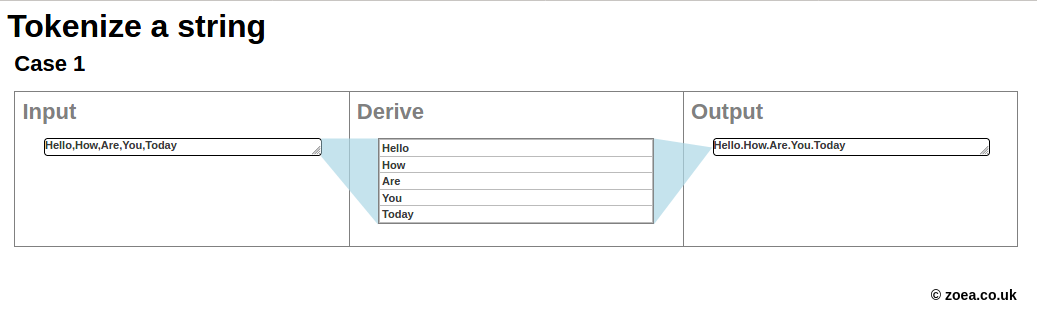
Zsh
str='Hello,How,Are,You,Today'
tokens=(${(s:,:)str})
print ${(j:.:)tokens}Or, using SH_SPLIT_WORD:
str='Hello,How,Are,You,Today'
IFS=, echo ${(j:.:)${=str}}- Programming Tasks
- String manipulation
- Simple
- 11l
- 360 Assembly
- 8080 Assembly
- 8086 Assembly
- AArch64 Assembly
- ACL2
- Action!
- Action! Tool Kit
- ActionScript
- Ada
- ALGOL 68
- Amazing Hopper
- APL
- AppleScript
- ARM Assembly
- Arturo
- Astro
- AutoHotkey
- AWK
- BASIC
- Applesoft BASIC
- BaCon
- BASIC256
- BBC BASIC
- Chipmunk Basic
- Commodore BASIC
- FreeBASIC
- Liberty BASIC
- MSX Basic
- PowerBASIC
- PureBasic
- QBasic
- Run BASIC
- VBScript
- Visual Basic
- Batch File
- BQN
- Bracmat
- C
- POSIX
- C sharp
- C++
- Boost
- Ceylon
- CFEngine
- Clojure
- CLU
- COBOL
- CoffeeScript
- ColdFusion
- Common Lisp
- Cowgol
- Crystal
- D
- Delphi
- System.SysUtils
- Dt
- Dyalect
- Déjà Vu
- E
- EasyLang
- Elena
- Elixir
- EMal
- Erlang
- Euphoria
- F Sharp
- Factor
- Falcon
- Fantom
- Fennel
- Forth
- Fortran
- Frink
- FutureBasic
- Gambas
- GAP
- Genie
- Go
- Groovy
- Haskell
- HicEst
- Icon
- Unicon
- Io
- J
- Java
- JavaScript
- Jq
- Jsish
- Julia
- K
- Klingphix
- Kotlin
- Ksh
- LabVIEW
- Lambdatalk
- Lang
- Lang5
- LDPL
- LFE
- Lingo
- Logo
- Logtalk
- Lua
- M2000 Interpreter
- M4
- Maple
- Mathematica
- Wolfram Language
- MATLAB
- Octave
- Maxima
- MAXScript
- Mercury
- Min
- MiniScript
- MMIX
- Modula-3
- MUMPS
- Nanoquery
- Nemerle
- NetRexx
- NewLISP
- Nial
- Nim
- Objeck
- Objective-C
- OCaml
- Oforth
- OoRexx
- OpenEdge/Progress
- Oz
- PARI/GP
- Pascal
- Perl
- Phix
- Phixmonti
- PHP
- Picat
- PicoLisp
- Pike
- PL/I
- PL/M
- Plain English
- Pop11
- PowerShell
- Prolog
- Python
- Q
- QB64
- Quackery
- R
- Racket
- Raku
- Raven
- REBOL
- Red
- Retro
- REXX
- Ring
- RPL
- Ruby
- Rust
- S-lang
- Scala
- Scheme
- Seed7
- Self
- Sidef
- Simula
- Slate
- Slope
- Smalltalk
- SNOBOL4
- Standard ML
- Swift
- Tcl
- Tr
- Transd
- TUSCRIPT
- TXR
- UNIX Shell
- UnixPipes
- Ursa
- Ursala
- Vala
- VBA
- Vedit macro language
- V (Vlang)
- WinBatch
- Wortel
- Wren
- XPath 2.0
- XPL0
- Yabasic
- Zig
- Zkl
- Zoea
- Zoea Visual
- Zsh
- PARI/GP/Omit
- Pages with too many expensive parser function calls